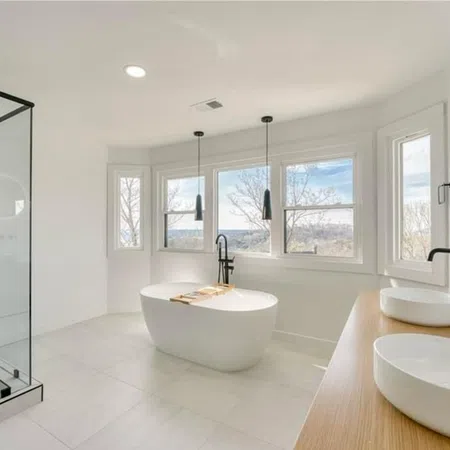
Porcelain tile absorbs no more than 0.5 percent of its weight in water, the threshold the tile industry uses to define porcelain, and that number is why it remains the best flooring for a bathroom with a tub or shower. Luxury vinyl plank is the strongest alternative, and wood-based floors only make sense in rooms without a bathing fixture. We install all of these materials in Atlanta-area homes, and the ranking below reflects how each one behaves after years of wet feet and steam.
The Kind of Bathroom Changes the Answer
A powder room has a toilet and a sink. No one showers there, humidity stays close to the rest of the house, and water on the floor is limited to an occasional splash. Almost any flooring survives those conditions, including hardwood.
A full bath is a different environment. Shower steam raises the humidity several times a day, and water regularly sits on the floor beside the tub. The floor in that room has to tolerate water on its surface and at its edges for hours at a time. Advice on the best bathroom flooring that ignores this difference steers people toward tile in rooms that never needed it, or toward laminate in rooms that will destroy it.
Porcelain Tile Tolerates the Most Water
Porcelain is fired dense enough that water barely enters the body of the tile. Standard ceramic tile absorbs more and still performs well on a residential bathroom floor. The weak points are the grout and what lies under the tile. Cement grout is porous and needs sealing, while newer high-performance grouts resist staining without a sealer. In a properly built tile flooring installation, a waterproof membrane or backer board sits beneath the tile so moisture that passes through the grout never reaches the plywood.
Traction deserves as much attention as water resistance. The industry standard for tile floors that will be walked on wet is a dynamic coefficient of friction of at least 0.42, and the figure appears on the product specification sheet. Matte finishes grip better than polished ones, and small-format tile adds traction because every grout line acts as an edge underfoot.
Luxury Vinyl Plank Is Waterproof at the Surface
The planks themselves are waterproof flooring for a bathroom. A vinyl or stone-polymer core does not swell, so vinyl bathroom flooring keeps its shape after a soaking that would ruin laminate. The seams are a different matter. Click-together planks lock tightly but are not sealed, and water from an overflowing toilet can pass between them or around the edges and sit on the subfloor underneath.
Installation details close most of that risk. A bead of 100 percent silicone at the tub and around the rest of the perimeter goes in before the trim, which keeps surface water on the surface. Rigid-core planks with a 20 mil wear layer hold up best in a busy family bath. The subfloor has to be flat, typically within 3/16 inch over 10 feet, or the joints will flex and eventually separate. Homeowners who choose waterproof vinyl plank flooring get a floor that is warmer and softer underfoot than tile and quicker to install.
Sheet vinyl deserves a mention for children's baths and rental units. It comes in wide rolls, so a small bathroom can be covered with no seams.
Laminate Belongs in Powder Rooms Only
Laminate has a fiberboard core, and fiberboard swells permanently once water reaches it. Water-resistant laminates have improved, yet their warranties cover spills wiped up within a set number of hours and exclude water that enters at the edges. Around a tub, the edges are exactly where water goes. Bathroom laminate flooring is a reasonable choice for a half bath and a poor one anywhere with a shower.
Hardwood Works in a Half Bath and Struggles in a Full Bath
Wood takes on moisture from the air as well as the floor. Daily steam swells the boards until their edges rise into a cupped shape. The finish breaks down first along the tub, where water sits longest. Atlanta summers already keep indoor humidity high, which leaves less margin than a dry climate would.
A powder room is a different case. Running the hallway hardwood straight through a half bath looks better than a transition in the doorway, and the conditions are mild enough for the floor to last. Site-finished floors have an advantage here because the finish coats bridge the joints between boards, while prefinished boards have beveled edges that let water into the seams. Engineered hardwood is more stable than solid, but its surface is still real wood and still needs spills wiped up.
The Subfloor Decides How Long Any Bathroom Floor Lasts
Most bathroom floor failures we see started below the surface. Slow leaks at the toilet flange and along the tub edge soften the plywood long before stains appear, and new flooring laid over a soft subfloor fails with it. Tile is the least forgiving, since it needs a floor stiff enough to stay within a deflection limit of L/360 or the grout cracks. Pulling the old floor during a bathroom remodeling project is the one chance to replace damaged sections and correct the flatness before anything new goes down.
Heated Floors Pair Best With Tile
Tile is cold and hard underfoot, which is its main drawback. Electric heating mats set in the mortar under the tile solve the cold-floor complaint, and tile conducts the heat efficiently. Vinyl plank can go over radiant heat in many cases, but manufacturers commonly cap the floor surface temperature near 85 degrees Fahrenheit. The limit is printed in the installation instructions and affects the warranty.
The Bathroom Floor Has to Meet the Hallway Floor
Bathroom floors rarely match the height of the floor outside the door. Solid hardwood is 3/4 inch thick, while tile over backer board often ends up taller and vinyl plank much lower. Planning the underlayment thickness in advance brings the two surfaces flush, and a stone threshold or a hardwood reducer handles whatever difference remains.
The Best Flooring for a Bathroom Comes Down to the Fixtures in the Room
A bathroom with a tub or shower should get porcelain tile, with luxury vinyl plank as the alternative when warmth underfoot or a faster installation matters more. A powder room can take either of those or continue the hardwood from the hall. TriArt Hardwoods installs all of these floors across Metro Atlanta, and a flooring estimate lets us check the subfloor and the transition heights before a material is chosen.