Hardwood Floor Repair in Atlanta, GA
Fixing What's Broken Without Redoing the Whole Floor.
Most damaged hardwood floors do not need replacing. A cupped board from a dishwasher leak, a patch of deep scratches where a dog spent five years, a stair tread that flexes underfoot, these are repairs, and they cost a fraction of what a new floor does.
Get a free estimate
What We Repair, and What Needs Replacing
The calls we take
Hardwood repair covers a wider range of problems than most homeowners expect. These are the six we are called for most in Atlanta homes.
When a Repair Beats a Full Refinish
Before you call anyone
Repair and refinishing solve different problems, and it is worth knowing which one you actually need before you start collecting quotes. There are three situations, and we will tell you which one you are in.
Matching Repairs Into an Existing Floor
The hard part
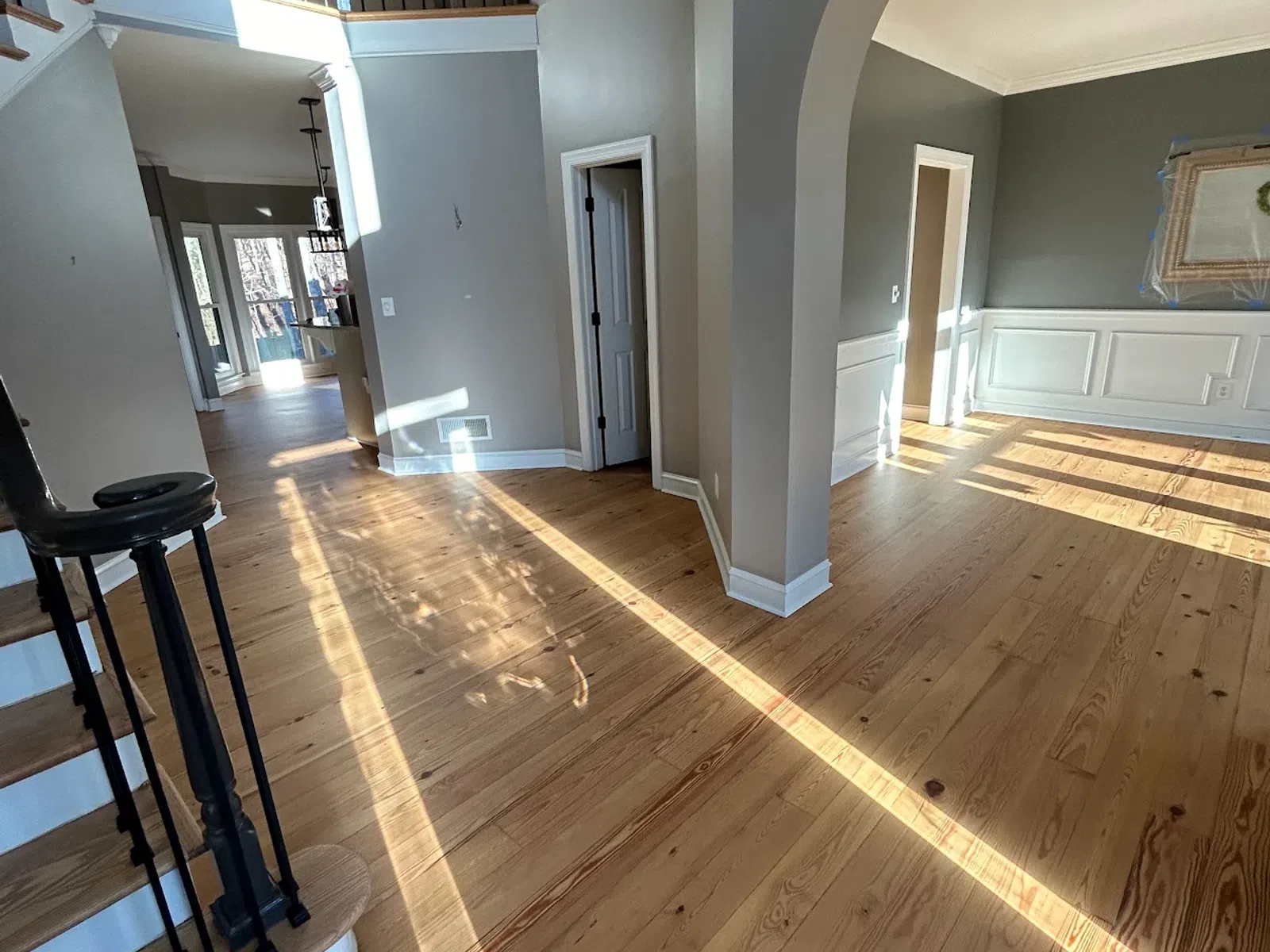
The hard part of hardwood repair is not replacing a board. It is making the replacement invisible.
A board installed today into a floor laid in 1994 will not match on its own. The existing wood has oxidized and shifted color for thirty years, the original stain has aged, and the finish has worn unevenly. New wood dropped into that gap reads as a patch from across the room.
What we look at before quoting: the species and cut of the existing wood, board width and thickness, whether the floor is site-finished or prefinished, how far the surrounding wood has ambered, and whether the boards run into a doorway or transition that gives us a natural stopping point. Sometimes the answer is a feathered repair blended into the surrounding boards. Sometimes it is repairing and then refinishing the full room so everything cures to one color. On a floor that has already been sanded several times, sometimes the honest answer is that replacement is the better investment.
We use DuraSeal stains and sample directly on your floor before committing to a color match.
With Water, Timing Decides the Outcome
Water damage
Water damage is the repair we are called for most, and how long the wood stayed wet changes the answer more than anything else about the floor. Roughly what we see:
How a Repair Visit Works
What to expect
Repair is harder to quote sight-unseen than installation or refinishing, because the extent of the damage is often not visible until we open the floor up. So we work in stages, and you approve each one.

Photos first
Send a few of the damaged area and the surrounding floor. We can usually tell you whether this is small, large, or something that needs a different solution entirely.

In-home assessment
We confirm what is happening below the surface, take moisture readings where water is involved, and check how far the damage actually travels.

Written scope and price
In front of you before any work starts. If we find something mid-repair that changes the scope, work stops and you approve the change before we continue.

The work
Small repairs are frequently done in a single visit. Repairs that need refinishing afterwards run longer, and furniture goes back 48 to 72 hours after the final coat.
Floor Repair Questions from Atlanta Homeowners
Repair questions
Can scratches be repaired without refinishing the whole floor?
Often, yes. Scratches that sit in the finish rather than the wood can usually be spot-repaired and blended. Deeper gouges that reach bare wood need filling and color matching, and if there are many of them in one room, refinishing that room may cost less than repairing each one individually.
How do you fix a squeaky hardwood floor?
Squeaks come from movement between the floor and the subfloor, so the fix depends on access. From below, in a basement or crawlspace, we can often shim or secure the subfloor without touching the finished floor. From above, the repair means fastening through the board and concealing the fastener. We determine what's possible during the assessment.
Can water-damaged hardwood floors be saved?
Sometimes. It depends on how long the wood stayed wet, how far the water traveled, and whether the subfloor is affected. Boards that dried quickly often flatten enough to sand and save. Boards that stayed saturated or have black staining generally need replacing. We assess moisture content before recommending anything.
Will the repaired area match the rest of my floor?
That is the goal, and it is the part of the job that takes the most skill. New wood doesn't naturally match wood that's aged for decades, so we test the stain on your actual floor before committing. On some floors, a blended repair is nearly invisible. On others, we recommend refinishing the room afterward so everything cures to a single color.
Do you charge for a repair estimate?
No. Send photos first, and we can often narrow the scope before anyone visits. If an in-home assessment is needed, that is free too, and you get a written scope and price before work begins.
My floor has been refinished several times. Can it be repaired again?
Possibly not, and that is worth knowing before you spend money. Solid hardwood can be sanded a limited number of times before the tongue-and-groove is compromised, and engineered wood has a thinner wear layer with less margin. We measure remaining thickness during the assessment and will tell you if replacement is the better investment.
Are you licensed to handle damage that goes past the floor?
Yes. TriArt Hardwoods is a licensed general contractor in Georgia (license RBCO008240) and carries insurance. The GC license matters more for repair work than for anything else we do, because water damage often extends past the floor into the subfloor or framing, and we can carry that work through rather than stopping at the flooring and handing you off to someone else.
What does hardwood floor repair cost in Atlanta?
Small repairs are usually a few hundred dollars. The number moves on how many boards come out, whether matching stock has to be sourced for an older floor, and whether the area needs refinishing afterward so the repair disappears. Send photos and we can narrow it before anyone visits.
Floor Repair Across Metro Atlanta
Where we work
Twelve cities from the Alpharetta showroom. Older in-town housing stock requires different repairs than the north metro: heart pine and 1920s oak versus engineered floors over slab. The project gallery shows recent repairs.