

Replacing carpet with hardwood flooring typically costs between $2,469 and $7,032, averaging around $4,722. Here’s a breakdown of the key expenses involved:
- Carpet removal: $0.70–$1.60 per sq. ft. ($140–$320 for a 200 sq. ft. room). Glued-down carpet costs more: $3.00–$5.10 per sq. ft.
- Hardwood materials: $3–$16 per sq. ft. for solid or engineered wood. Prefinished boards save on labor costs.
- Installation labor: $3–$8 per sq. ft. Complex patterns or stairs cost extra.
- Subfloor prep: $3–$10 per sq. ft. for repairs. Moisture barriers add $0.50–$5.50 per sq. ft.
Costs vary based on room size, wood type, and subfloor condition. For a 200 sq. ft. room, expect $1,100–$3,800. Larger spaces or premium wood can increase costs significantly. Removing carpet yourself can save $1–$2 per sq. ft.
Quick Tip: Opt for domestic woods like red oak to reduce material costs. Prefinished planks can also lower labor expenses.
How to Install Hardwood Floor – Replace Carpet with Pro Install of Bruce Hard wood
sbb-itb-9f8f869
Carpet Removal Costs
Getting carpet removed comes with its own set of expenses. Homeowners typically spend between $0.70 and $1.60 per square foot for professional removal. This price includes pulling up the carpet, taking out the padding underneath, and removing the tack strips along the edges. For a standard 200-square-foot bedroom, that translates to about $140 to $320 in labor costs alone.
Removing wall-to-wall carpet that’s stapled down is usually the simplest and cheapest option. However, if the carpet is glued down, the process becomes more labor-intensive, as the adhesive residue on the subfloor must be scraped off. This increases costs to $3.00 to $5.10 per square foot. Additionally, most contractors impose a minimum service charge of $150 to $200, regardless of the room’s size. For those living in high-cost metro areas, labor rates can range from $40 to $125 per hour.
Let’s break down the labor and other factors that influence these costs.
Labor Costs for Carpet Removal
A professional team typically needs two to four hours to clear out a standard 12-by-12-foot room. If the tack strips can’t be reused, removing them adds $0.40 to $0.50 per linear foot. Staircases are more expensive, costing $7 to $10 per step for standard carpet removal or up to $25 per step for glued-down carpet.
Want to save some money? Move your furniture before the crew arrives. Contractors often charge $0.20 to $0.30 per square foot (or $25 to $75 per room) for furniture moving. Taking care of this yourself can trim down your overall bill.
Disposal and Haul-Away Fees
Disposal fees are another cost to consider, and they’re often overlooked during budgeting. Professional haul-away services usually charge about $0.45 to $0.60 per square foot, or they may quote a flat fee of $50 to $100. If you’re handling the removal yourself, hiring a junk removal service can cost anywhere from $75 to $350 per load.
Make sure to ask your contractor if their estimate includes disposal fees. Some bundle it into the total price, while others list it separately. For a more eco-friendly route, you can check out the Carpet America Recovery Effort (CARE) database to find local recycling drop-off sites. Recycling fees generally range from $0.05 to $0.26 per square foot. Alternatively, some municipalities accept carpet as bulk trash, but they often require it to be cut into smaller strips and scheduled for a special pickup.
| Disposal Method | Typical Cost |
|---|---|
| Professional haul-away (per sq. ft.) | $0.45 – $0.60 |
| Professional haul-away (flat fee) | $50 – $100 |
| Junk removal service (per load) | $75 – $350 |
| Recycling center (per sq. ft.) | $0.05 – $0.26 |
Source:
Hardwood Material Costs
Once the carpet is removed, the next step is budgeting for hardwood flooring. Prices can vary significantly based on factors like the type of wood, plank size, and quality. Over the past five years, hardwood flooring costs have increased by 11.1%.
Solid Hardwood Flooring Costs
Solid hardwood, crafted from a single piece of wood, is known for its durability and the ability to be refinished multiple times. Prices for materials typically range from $3 to $10 per square foot, with high-end options reaching $16 per square foot. If you’re looking for affordability, domestic woods like red oak (around $2–$6 per square foot) and maple (approximately $3–$10 per square foot) are good choices. On the other hand, exotic woods such as teak ($9–$13 per square foot) and Brazilian walnut ($5–$10 per square foot) tend to be more expensive.
The thickness and grade of the planks also play a role in pricing. Here’s a tip: consider prefinished boards to save on labor costs. As Stephanie Minasian-Koncewicz from This Old House points out:
"Unfinished boards are less expensive but have higher labor costs since the finishing must be done on-site".
While prefinished boards add about $2 per square foot to material costs, they can save between $2 and $7 per square foot in labor expenses for onsite finishing.
Engineered Hardwood Flooring Costs
Engineered hardwood is constructed with a real wood veneer layered over plywood or fiberboard. It’s designed for better stability in humid environments and is often more budget-friendly than solid hardwood. The table below highlights material and installation costs for both options.
The thickness of the veneer is a key factor. Basic-grade engineered wood, with a thin 1/16-inch veneer, costs around $5–$9 per square foot installed but usually can’t be refinished. Mid-grade options, priced at $6–$12 per square foot installed, are more durable and suitable for active households. High-end boards with a thicker 1/6-inch veneer cost between $13 and $20 per square foot installed and can be refinished once or twice.
Rich Grady, a wood flooring expert, explains the construction advantage of engineered hardwood:
"What they’ve done is alternated the grain patterns. So you have grain running this way, the opposing grain running that way. This cross-grain construction prevents the buckling issues that can plague solid wood floors."
| Type | Material Cost per Sq. Ft. | Installed Cost per Sq. Ft. |
|---|---|---|
| Solid Hardwood | $3–$16 | $5–$28 |
| Engineered Hardwood | $3–$16 | $6–$23 |
When choosing between the two, consider the location. Engineered hardwood is better suited for areas prone to moisture, like basements or spaces with concrete subfloors. For main living areas, solid hardwood offers long-term value, as it can be refinished 3–5 times over its impressive lifespan of 75–100 years.
Next, we’ll look at how installation labor costs fit into your overall flooring budget.
Installation Labor Costs
When planning for hardwood flooring, labor costs are a significant part of the budget. For standard installation, you can expect to spend $3 to $8 per square foot, but the exact price depends on factors like where you live, the installer’s experience, and the job’s complexity. Two key elements that influence labor costs are the layout pattern and stair installation.
Layout patterns play a big role in determining costs. A straightforward, straight-lay installation in a rectangular room is the most economical. However, more intricate designs like diagonal, herringbone, or chevron patterns can drive labor costs much higher. As Sara Kendall explains:
"Complex patterns like herringbone can double labor costs compared to a straight-lay installation."
These patterns often add about 30% to the total installation cost due to the additional cuts and material waste they require. Stairs, on the other hand, are priced separately from flat flooring. Installing hardwood on stairs demands precise measurements and detailed trim work, making it more time-intensive. Costs typically range from $75 to $200 per step, with prices climbing for more complex designs like spiral or curved staircases. Regional labor rates can also vary, so getting local estimates is crucial.
You can lower labor costs by handling some prep work yourself. For instance, clearing the room, moving furniture, and removing old baseboards before the installers arrive can save time and money. If you’re installing hardwood in multiple rooms, scheduling everything together might help you negotiate a better rate per square foot.
| Labor Task | Estimated Cost |
|---|---|
| Standard Installation (Nail/Float) | $3–$8 per sq. ft. |
| Complex Layouts (Herringbone/Glue-down) | $8–$10+ per sq. ft. |
| Unfinished Wood (Sanding/Staining) | $2–$7 per sq. ft. additional |
| Trim and Molding Installation | $4–$10 per linear foot |
| Hardwood Stair Installation | $75–$200 per stair |
Investing in professional installation can save you from costly repairs down the line. Up next, we’ll dive into subfloor preparations and other potential charges.
Subfloor Preparation and Additional Expenses
Getting your subfloor ready is a key step in ensuring your hardwood flooring looks and performs its best. Once the carpet comes up, you’ll finally see the condition of the subfloor, which can sometimes impact your budget. As general contractor Bob Tschudi notes:
"Subfloor replacement can be straightforward or very involved. You usually can’t see the extent of any underlying problems until you remove the top layers of flooring and subflooring."
This section breaks down the costs involved in preparing your subfloor and highlights why setting aside a contingency fund for surprises is a smart move.
Subfloor Leveling and Repairs
A flat, sturdy subfloor is non-negotiable for hardwood installation. Even small dips or uneven spots can lead to creaking floors, instability, or gaps that ruin the look of your new flooring. Leveling involves grinding down high areas or filling in low spots with a leveling compound. If subfloor boards are damaged, they might need to be replaced entirely, which typically costs $3 to $10 per square foot. For a 300-square-foot room, this could range from $900 to $3,000.
If the problem extends to the floor joists underneath, brace yourself for additional costs. Repairs for joists usually fall between $100 and $300 per joist. In severe cases requiring extensive structural work, expenses can climb to $2,000–$5,000.
Moisture Barriers and Underlayment
Moisture is hardwood flooring’s worst nightmare – it can cause warping or buckling over time. That’s why installing a moisture barrier, especially over concrete slabs, is crucial. A basic plastic moisture barrier or sound-dampening underlayment adds about $0.50 to $1.50 per square foot to your costs. Higher-end options can go up to $5.50 per square foot. If you’re combining leveling work with moisture protection, plan for an average cost of $2.00 per square foot for materials and labor.
Trims, Transitions, and Door Adjustments
Finishing touches like trims and transitions are often billed separately from the main installation. Transition pieces – such as T-molds, reducers, and end caps – help create a seamless look between your new hardwood and other types of flooring. Baseboards or shoe molding are used to cover the expansion gaps along the room’s edges.
Another detail to consider is door adjustments. Since hardwood usually sits higher than carpet, installers may need to shave down the bottom of doors for proper clearance. Be sure to confirm with your installer if these finishing costs are included in your quote.
| Additional Expense | Estimated Cost |
|---|---|
| Subfloor Repair (General) | $900–$3,000 per project |
| Subfloor Replacement (Per Sq. Ft.) | $3–$10 per sq. ft. |
| Floor Joist Repair | $100–$300 per joist |
| Moisture Barrier / Underlayment | $0.50–$5.50 per sq. ft. |
| Leveling & Moisture Prep (Combined) | ~$2.00 per sq. ft. |
Total Project Cost by Room Size
When you factor in carpet removal, hardwood materials, labor, and prep work, the total cost for installing hardwood flooring typically ranges from $6 to $25 per square foot. On average, most homeowners spend about $10 per square foot installed, with the typical project costing around $4,722.
"The national average cost to install hardwood flooring is $6 to $12 per square foot for labor and material fees. For higher-end wood and larger spaces… you may pay more – possibly between $13 and $25 per square foot." – Stephanie Mickelson, Contributing Writer, Angi
These estimates include key components like carpet removal ($1–$2/sq. ft.), hardwood materials ($3–$15+/sq. ft.), installation labor ($3–$8/sq. ft.), and prep and finishing work ($0.50–$7/sq. ft.). Smaller rooms often come with higher per-square-foot costs due to additional cuts and limited working space.
Cost Breakdown for Small, Medium, and Large Rooms
One way to reduce costs? Remove the carpet yourself. This simple DIY effort can save $1–$2 per square foot, which adds up to as much as $300 on a 200-sq.-ft. room. Below is a breakdown of how costs vary by room size.
| Room Size | Square Footage | Estimated Total Cost Range |
|---|---|---|
| Small (bedroom or office) | 150–200 sq. ft. | $1,100–$3,800 |
| Medium (living or dining room) | 250–500 sq. ft. | $1,800–$13,000 |
| Large (open floor plan) | 1,000–1,500 sq. ft. | $6,000–$36,400 |
These ranges reflect variables like the type of wood, finish, subfloor condition, and labor rates in your area. For instance, opting for domestic woods like red oak or hickory instead of exotic species like teak can reduce material costs by up to 50%. Similarly, choosing prefinished planks can eliminate the need for on-site sanding and sealing, saving $2–$7 per square foot.
Solid vs. Engineered Hardwood: Cost and Use Case Comparison
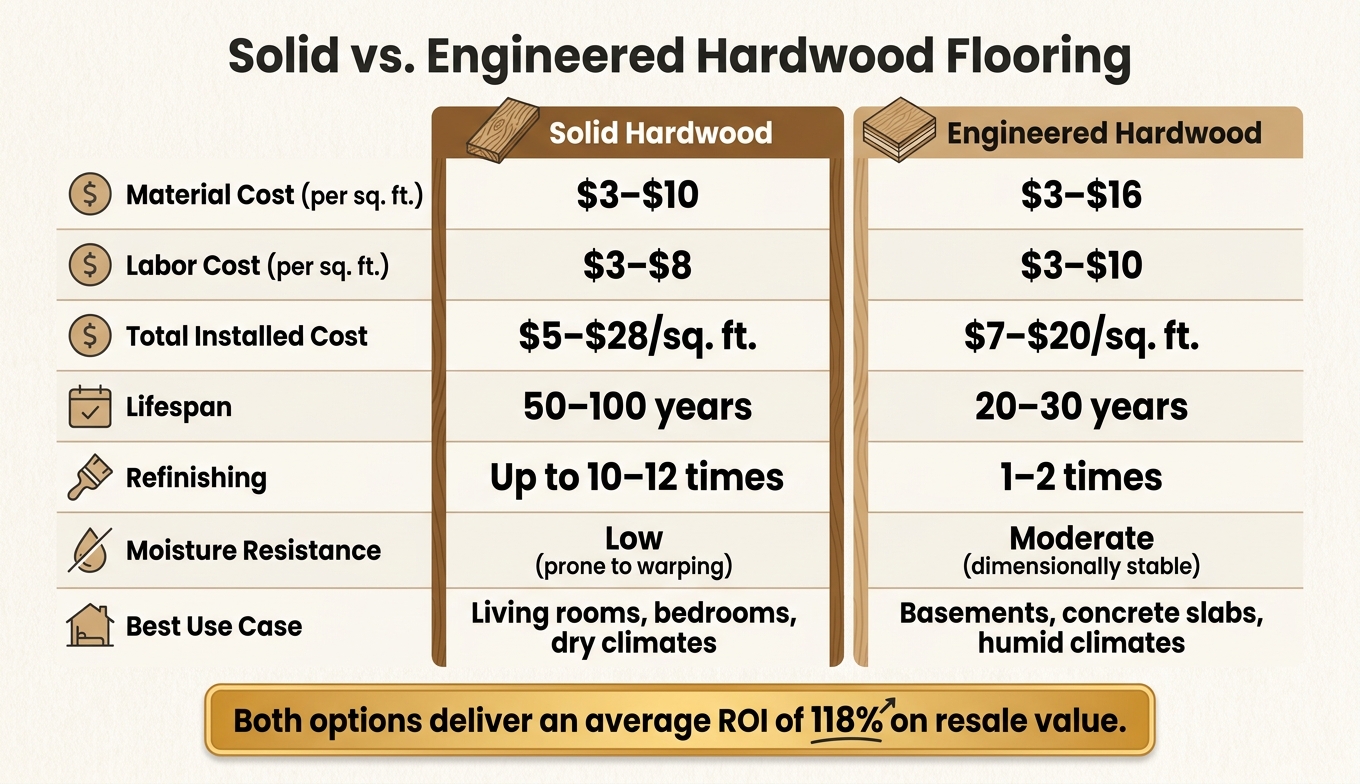
Solid vs. Engineered Hardwood Flooring: Cost & Feature Comparison
When deciding between solid and engineered hardwood, it’s essential to consider where the flooring will be installed, how long you want it to last, and your budget. Both are made from real wood, but they perform quite differently once installed.
Solid hardwood is crafted from a single piece of wood, typically 3/4" thick. This thickness allows it to be refinished multiple times, giving it a lifespan of 50 to 100 years. However, it doesn’t handle moisture well, making it unsuitable for basements or areas with significant humidity fluctuations.
Bruce Janetta, a flooring contractor, highlights the durability of solid hardwood but also its limitations over time:
"We figured that these floors have been sanded 10, maybe 12 times. And because of it, there isn’t much usable wood left."
Engineered hardwood, on the other hand, features a real wood veneer layered over plywood arranged in alternating grain directions. This design provides stability, reducing the risk of buckling or warping, which is especially useful for concrete subfloors, basements, or humid environments. Rich Grady, a wood flooring expert, explains the advantage of this structure:
"What they’ve done is alternated the grain patterns. So you have grain running this way, the opposing grain running that way. This cross-grain construction prevents the buckling issues that can plague solid wood floors."
While engineered hardwood offers better moisture resistance, it has a shorter lifespan of 20–30 years and can only be refinished 1–2 times before the veneer wears too thin. If you choose engineered wood, aim for a veneer thickness of at least 1/6" to ensure it can be refinished at least once.
Here’s a breakdown of the key differences between solid and engineered hardwood:
Comparison Table
| Feature | Solid Hardwood | Engineered Hardwood |
|---|---|---|
| Material Cost (per sq. ft.) | $3–$10 | $3–$16 |
| Labor Cost (per sq. ft.) | $3–$8 | $3–$10 |
| Total Installed Cost | $5–$28 per sq. ft. | $7–$20 per sq. ft. |
| Lifespan | 50–100 years | 20–30 years |
| Refinishing | Up to 10–12 times | 1–2 times |
| Moisture Resistance | Low; prone to warping | Moderate; dimensionally stable |
| Best Use Case | Living rooms, bedrooms, dry climates | Basements, concrete slabs, humid climates |
For long-term value, solid hardwood tends to be more cost-effective if you plan to stay in your home for decades, as it can be refinished rather than replaced. However, if you’re dealing with a humid climate or a concrete subfloor, engineered hardwood is the safer and more practical choice. Both options offer excellent resale value, with new hardwood floors delivering an average ROI of 118%, regardless of type.
This guide should help you decide which hardwood flooring option aligns best with your needs and budget.
Conclusion: Planning Your Hardwood Flooring Budget
When planning your hardwood flooring budget, several factors come into play: the type of hardwood, the condition of your subfloor, the complexity of your space, and the finishing options you choose. The overall cost hinges on materials, labor, and preparation, so understanding these elements can help you make informed decisions.
One way to manage costs is by choosing prefinished boards, which reduce on-site labor expenses. Opting for a common domestic wood species like Red Oak can also help keep material costs more affordable compared to pricier exotic options. Don’t forget to factor in potential subfloor repairs, as neglecting these can lead to unexpected expenses.
It’s wise to set aside a 15–20% contingency for surprises like moisture damage, weak framing, or other structural issues that might only become apparent once the carpet is removed. As This Old House suggests:
"Get a detailed written estimate outlining preparation, installation price per square foot, finishing, and warranty information from at least three companies you’re considering."
Working with seasoned professionals can make all the difference. Experienced installers can identify hidden problems, address moisture concerns, and ensure your flooring stands the test of time. Every home is unique, so your final cost will reflect the specific choices and conditions of your project.
For Atlanta homeowners, TriArt Hardwoods offers expert installation, thorough subfloor preparation, and clear, itemized estimates. Contact TriArt Hardwoods to schedule a consultation and get a personalized quote tailored to your space and vision.
FAQs
What should I ask a flooring contractor to include in a written estimate?
When asking for a written estimate from a flooring contractor, be sure it includes the following details:
- Cost Breakdown: A clear outline of expenses for both carpet removal and hardwood installation, covering labor and materials.
- Additional Fees: Any extra charges, such as subfloor preparation or disposal costs.
- Hardwood Type: Specify whether the hardwood is solid or engineered, along with its associated costs.
- Square Footage: The total area to be covered and how it impacts the overall pricing.
- Itemized List: A breakdown of materials, finishes, and any preparatory work required for the project.
This level of detail helps you fully understand the costs and scope of the work.
How do I know if I need subfloor repairs or a moisture barrier?
If you notice signs of rot, warping, or mold on your subfloor, it’s a clear indication that repairs are necessary. Additionally, if you live in an area with high humidity or frequent moisture, installing a moisture barrier can help protect your subfloor from future issues like mold or warping. For the best results, it’s a good idea to consult a flooring professional who can assess your specific situation and recommend the right course of action.
Will my doors and baseboards need to be adjusted after hardwood installation?
After installing hardwood flooring, you might need to adjust your doors and baseboards. This could involve trimming door casings or even replacing base moldings to ensure everything fits properly. These adjustments not only accommodate the height difference created by the new flooring but also help create a smooth, polished appearance.


