

Hardwood flooring is a long-lasting, stylish, and practical choice for your home. It can boost your home’s value by up to 10% and, with proper care, last 25 to 100+ years, depending on the type. Here’s what you need to know to make the best choice:
- Durability Matters: For high-traffic areas, choose harder woods like Hickory (Janka rating: 1,820 lbf) or White Oak (1,360 lbf). Softer woods like Walnut (1,010 lbf) work better in low-traffic spaces.
- Room-Specific Needs: Use engineered hardwood in moisture-prone areas like basements and kitchens. Solid hardwood is best for above-grade spaces.
- Aesthetic Choices: Mid-tone options like natural White Oak balance appearance and maintenance. Matte or textured finishes hide scratches better.
- Solid vs. Engineered: Solid hardwood lasts longer and can be refinished more often, but engineered hardwood resists moisture better and works in more locations.
- Budgeting: Costs range from $6 to $25 per square foot, including materials and labor. Order 5–10% extra material to account for waste.
How To Choose The Best Hardwood Flooring
sbb-itb-9f8f869
Assess Your Lifestyle and Room Requirements
Before you get attached to a specific wood type or finish, think about how your home functions on a daily basis. The perfect flooring for a serene bedroom might not survive the chaos of a bustling household full of kids, pets, and constant activity.
Consider Daily Wear and Tear
High-traffic areas like hallways and living rooms demand durable wood with a Janka hardness of at least 1,300 lbf to withstand wear and tear. While Red Oak (1,290 lbf) is a common standard, tougher options like Hickory (1,820 lbf) are better suited for busy homes.
If you have pets or children, expect scratches and dents. Pet nails and everyday impacts can damage softer woods like Cherry (950 lbf) or Walnut (1,010 lbf). Harder woods such as Hickory and White Oak are more resistant, and finishes like matte or textured styles can help hide minor damage. Regular cleaning is also key to combat the abrasive effects of daily foot traffic.
Keep in mind that dark floors tend to highlight dust and scratches, while light floors make stains and watermarks more noticeable. Mid-tone options, like honey Hickory or natural White Oak, strike a good balance between aesthetics and maintenance.
Ultimately, durability and appearance requirements differ by room, so it’s important to choose flooring tailored to each space.
Understand Room-Specific Requirements
Every room has its own set of challenges. Kitchens, for example, deal with frequent spills and moisture tracked in from outside. If liquids aren’t cleaned up quickly, they can seep into the joints, causing discoloration, finish problems, or even warping. Engineered hardwood is a great fit for kitchens because it offers better stability in these conditions.
Basements come with their own complications. Solid hardwood doesn’t work well below ground level, as it’s vulnerable to moisture from concrete slabs. Engineered hardwood, on the other hand, is designed to resist moisture and is the better choice for basement installations. Bedrooms, which see less traffic, are more forgiving. This makes softer, decorative woods like Walnut or Cherry suitable for these quieter spaces.
To keep your floors in top shape, maintain indoor humidity levels between 35% and 55%. Using humidifiers during the winter and dehumidifiers in the summer can help prevent issues like warping or cracking.
Choose the Right Wood Species
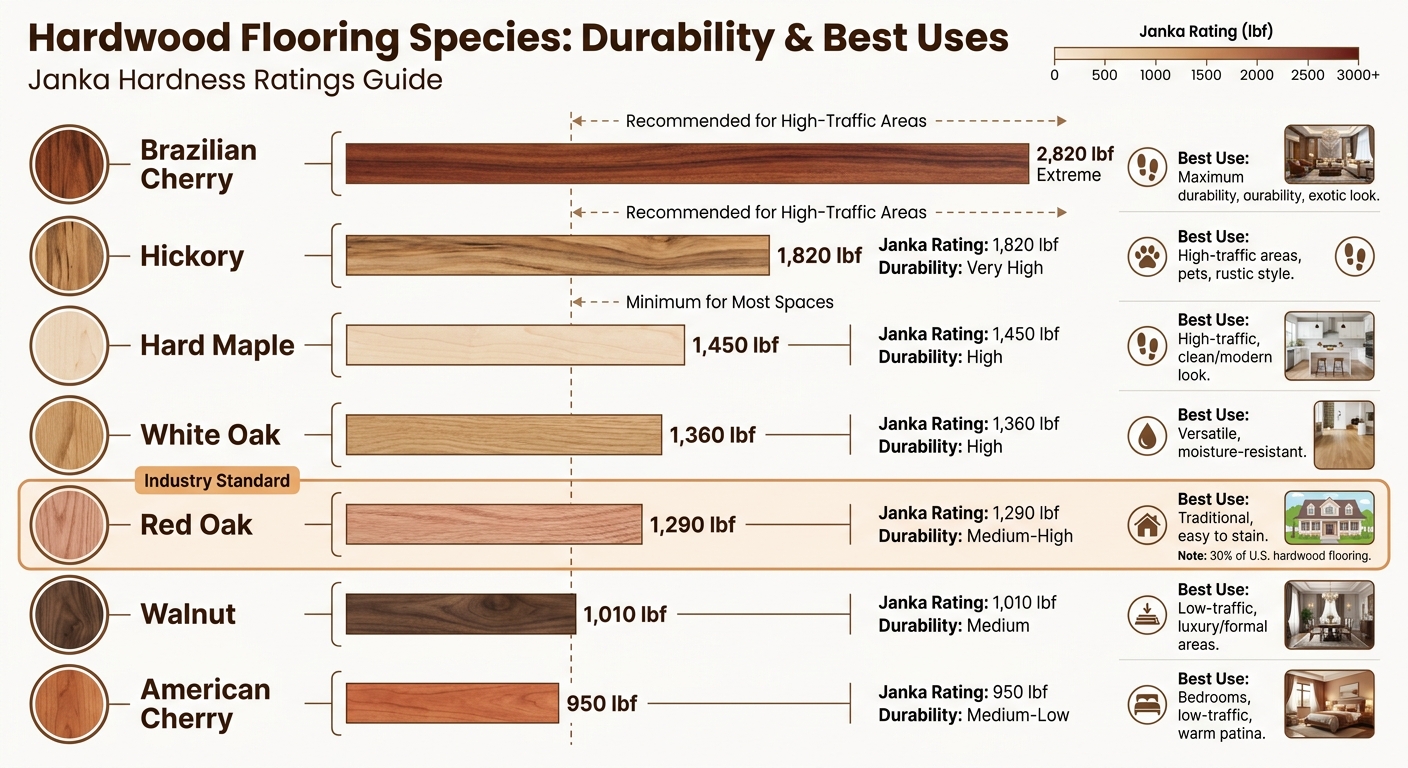
Hardwood Flooring Species Comparison: Janka Ratings and Best Uses
Once you’ve considered your lifestyle and the specific needs of your rooms, it’s time to choose the wood species that fits both your practical and aesthetic goals. The ideal wood should balance durability, stability, and style to suit your home.
Compare Janka Hardness Ratings
The Janka test measures how resistant wood is to dents and wear – an essential factor for high-traffic areas. A higher Janka rating means tougher wood. For most spaces, aim for species rated above 1,000 lbf, while high-traffic zones may need ratings closer to or exceeding 1,300 lbf.
"The Janka hardness test measures a wood species’ resistance to denting and wear. Higher ratings indicate harder, more durable flooring – critical for high-traffic areas." – 2020 Flooring
Red Oak, the industry standard, has a Janka rating of 1,290 lbf and accounts for over 30% of hardwood flooring in the U.S.. If you need something tougher – especially for homes with kids or pets – consider Hickory (1,820 lbf), Hard Maple (1,450 lbf), or White Oak (1,360 lbf). For less demanding spaces like bedrooms or formal sitting areas, softer woods like Walnut (1,010 lbf) or American Cherry (950 lbf) are excellent choices.
| Species | Janka Rating (lbf) | Durability | Best Use Case |
|---|---|---|---|
| Brazilian Cherry | 2,820 | Extreme | Maximum durability, exotic look |
| Hickory | 1,820 | Very High | High-traffic, pets, rustic style |
| Hard Maple | 1,450 | High | High-traffic, clean/modern look |
| White Oak | 1,360 | High | Versatile, moisture-resistant |
| Red Oak | 1,290 | Medium-High | Traditional, easy to stain |
| Walnut | 1,010 | Medium | Low-traffic, luxury/formal areas |
| American Cherry | 950 | Medium-Low | Bedrooms, low-traffic, warm patina |
Beyond hardness, consider how grain patterns affect scratch visibility. Tight-grain woods like Maple resist scratches better but make them more noticeable when they occur. Open-grain species like Oak may scratch more easily, but the grain can help camouflage the damage.
Once you’ve assessed durability, focus on how each species fits your design preferences.
Balance Aesthetics and Practicality
Every wood species brings distinct colors and grain patterns that can elevate your home’s style. White Oak is a top choice for 2025, thanks to its neutral-to-warm undertones and versatility in both modern and farmhouse designs. Its closed grain structure also makes it more resistant to moisture compared to Red Oak, which has a more porous grain and pinkish-red undertones.
"White oak is widely used because it combines strength, stability, and a beautiful grain pattern. It accepts stain evenly and has a neutral tone that pairs well with both light and dark colors." – Hardwoods4Less
For a rustic or farmhouse vibe, Hickory’s bold grain and color variation are ideal, though it requires careful humidity control due to its dimensional instability. Hard Maple, with its clean and consistent appearance, suits modern spaces but may show scratches more easily due to its smooth surface. Black Walnut, with its rich chocolate tones, is perfect for formal or mid-century modern interiors, though its softness makes it less practical for busy areas.
When selecting wood, focus on matching undertones rather than exact colors. Always test full-size samples in your space for 48 hours to see how lighting affects the appearance. Currently, warm honey tones are trending, while cool grays are becoming less popular. Be aware that some species, like American Cherry and Black Walnut, are photosensitive – Cherry darkens with light exposure, while Walnut lightens over time.
Finding the right balance between durability and style will set the stage for decisions about plank width, finishes, and installation patterns in the next steps of your project.
Solid vs. Engineered Hardwood: Making the Right Choice
Once you’ve settled on a wood species, the next big decision is choosing between solid hardwood and engineered hardwood. This choice impacts where you can install the flooring, how it performs over time, and how well it adapts to your home’s conditions.
Key Differences Between Solid and Engineered Hardwood
Solid hardwood is crafted from a single piece of natural wood, usually 3/4-inch thick. In contrast, engineered hardwood consists of a hardwood veneer layered over a plywood core. This layered structure gives engineered hardwood better resistance to changes in humidity, which can cause wood to expand or contract.
Solid hardwood stands out for its durability and ability to be refinished multiple times, lasting over a century. Engineered hardwood, while more stable, typically allows for 1–2 refinishing cycles and has a lifespan of 30–60 years. If refinishing is a priority, look for engineered options with a thicker wear layer (ideally 4mm–6mm).
| Feature | Solid Hardwood | Engineered Hardwood |
|---|---|---|
| Composition | 100% solid wood | Hardwood veneer over plywood core |
| Thickness | Typically 3/4" | 3/8" to 9/16" |
| Installation | Nail or staple only | Nail, glue, staple, or float |
| Location | Above-grade only | All levels, including basements |
| Moisture Resistance | Low (prone to warping) | High (dimensionally stable) |
| Refinishing | 8–10 times | 1–2 times (if wear layer allows) |
| Lifespan | 100+ years | 30–60 years |
| Radiant Heat | Less suitable | Compatible |
When it comes to cost, solid hardwood typically ranges from $5 to $25 per square foot, while standard engineered hardwood falls between $3 and $7 per square foot. Premium engineered options, however, can rival solid wood prices due to their more intricate construction.
These differences play a major role in determining which type works best for your specific installation needs.
Selecting Based on Installation Location
The environment where you plan to install the flooring is just as important as the material itself. Factors like moisture levels and the type of subfloor significantly influence your decision.
Solid hardwood requires a wood-based subfloor, such as 3/4-inch plywood, and is limited to above-grade installations (ground level or higher). It’s not suitable for concrete slabs unless you’re willing to install a plywood subfloor, which can be costly and add height.
"Water is the enemy of solid hardwood. For that reason, you’ll never find it installed below ground in basements or anywhere where you can expect moisture." – Janine & Michael, Floor & Decor CT
Engineered hardwood is the better choice for below-grade spaces like basements, thanks to its stability. It’s also a great option for kitchens and rooms with radiant heating systems. If you’re considering wide planks (over 5 inches), engineered wood is less prone to the gapping and movement that can occur with solid wood in wider formats.
One thing to consider: engineered hardwood installed as a floating floor can sometimes feel hollow underfoot. For a more traditional, solid feel, opt for stapling or gluing the planks.
Decide on Plank Width, Finish, and Patterns
Once you’ve chosen your wood species and installation type, it’s time to focus on the details that will shape the overall look and durability of your flooring. These include plank width, finish, and installation patterns.
Plank Width Options and Their Effect
Plank width plays a big role in defining the atmosphere of a room. Here’s how different widths can impact your space:
- Narrow planks (2–3 inches): These create a timeless, linear look that can make smaller rooms feel more spacious. They’re also ideal for complex patterns like herringbone or chevron.
- Standard planks (around 5 inches): As the most versatile option, these work well with a variety of styles, including rustic and farmhouse designs.
- Wide planks (5–12+ inches): These offer a high-end, luxurious feel with fewer seams, allowing the wood’s natural grain to stand out.
"The magic of wide plank flooring lies in its visual effect. Because the boards are wider, there are far fewer seams running across your floor. This creates a clean, uninterrupted surface that makes any room feel larger and more open." – USA Builders Depot
For smaller rooms, consider narrow planks or lighter-toned wide planks (up to 8 inches) to keep the space feeling open. Larger, open-concept areas benefit from wide planks (6 inches or more), which create a seamless and cohesive flow. As for cost, narrow planks range from $3–$10 per square foot, standard planks from $3–$13, and wide planks from $4–$18+ per square foot.
Selecting the Best Finish for Your Needs
The finish you choose not only affects the appearance of your floors but also their ability to withstand daily wear and tear.
- Matte and satin finishes are popular for their ability to hide scratches and pet hair better than high-gloss options. If you have kids or pets, these finishes are a practical choice.
- Aluminum oxide finishes, often factory-applied to prefinished boards, provide outstanding durability and a long lifespan.
- Water-based polyurethane dries quickly and maintains the wood’s natural color, while oil-based polyurethane adds a warm, amber tone.
- For a natural, matte look, hardwax oil is a good option, though it does require more frequent maintenance.
Textured finishes, such as wire-brushed, hand-scraped, or distressed styles, are excellent for high-traffic areas as they help mask wear and scratches. Always test samples of finishes in your space under different lighting conditions, as the color and sheen can shift dramatically between natural and artificial light.
Patterns to Elevate Your Flooring Design
The way you arrange your planks can add another layer of visual interest to your flooring.
The straight layout is the most common and straightforward, but a diagonal arrangement can add a unique twist while also reinforcing single-layer subfloors. For a more striking design, consider herringbone or chevron patterns. These intricate layouts require narrow planks (2–3 inches) and professional installation. While narrower planks create a traditional, rhythmic look often seen in historic homes, wider planks highlight the wood’s natural beauty.
Each of these choices – width, finish, and pattern – allows you to tailor your flooring to your personal style and practical needs, creating a space that’s both functional and visually appealing.
Budgeting for Your Hardwood Flooring Project
Once you’ve picked the perfect wood and design, the next step is making sure your budget aligns with your vision.
Understanding Material and Installation Costs
Hardwood flooring costs generally fall between $6 and $25 per square foot, which includes both materials and labor. For a 1,000-square-foot space, this means you’re looking at a total cost ranging from $6,000 to $25,000.
The type of wood you choose plays a big role in material costs. If you’re working with a tighter budget, options like Pine ($2–$4 per square foot) and Red Oak ($2–$11 per square foot) provide good value. On the other hand, premium woods like Brazilian Walnut ($5–$15 per square foot) and Teak ($9–$13 per square foot) come with a higher price tag [28,29]. Plank thickness also matters – thinner boards (5/16 inch) cost around $2–$5 per square foot, while standard 3/4-inch planks range from $3–$16 per square foot [28,29].
Labor costs for installation typically add another $3 to $8 per square foot [28,29]. If you’re considering intricate patterns like herringbone or using harder woods, expect those costs to be on the higher end. Don’t forget additional expenses like removing old flooring ($1–$5 per square foot), preparing the subfloor ($3–$10 per square foot), and adding underlayment ($0.75–$2 per square foot). If your subfloor needs repairs due to water damage or structural issues, you could be looking at an extra $1,000–$3,000 or more.
To strike a balance between quality and cost, consider "Common Grade" wood, which is priced at $6–$18 per square foot, compared to $8–$23 per square foot for premium "Clear and Select Grade" wood. Opting for plain-sawn planks instead of quarter-sawn or rift-sawn cuts can also help save money without sacrificing style.
These estimates provide a solid starting point for budgeting your project, but there are additional ways to manage costs effectively.
Minimizing Waste and Defects
Reducing waste is key to keeping costs down. Always order 5–10% more material than your measured square footage to account for cutting and natural defects. Allowing the wood to acclimate for 1–2 weeks before installation can also prevent issues like warping or gaps, which can lead to costly fixes. While higher-quality wood may cost more upfront, it often has fewer defects, which means less waste during installation.
Maintaining a stable indoor environment – humidity levels between 30% and 50% and temperatures between 60°F and 80°F – is crucial for preserving your floors over time.
Proper installation is equally important. Flooring contractor Bruce Janetta highlights the risks of poor technique:
"If you nail it too close to the end, they will split the tongue all the way along, they won’t get the next board together with".
Hiring skilled professionals can help avoid mistakes that waste materials or delay the project.
Lastly, inspect your subfloor after removing old flooring. Identifying issues early allows you to plan for repairs and avoid surprise expenses later on [28,29]. Adding moisture barriers – especially over concrete or in humid areas – can also prevent problems like buckling or cupping, which could require a full floor replacement down the line.
Conclusion
When choosing hardwood flooring, it’s all about finding the right balance between your lifestyle, aesthetic preferences, and budget. Start by thinking about how each room will be used. For high-traffic areas or homes with kids and pets, harder wood species like Hickory (1,820 lbf) or White Oak (1,360 lbf) are excellent options. In contrast, quieter spaces can handle softer woods like Walnut or Cherry. If you’re dealing with moisture-prone areas, such as basements, engineered hardwood is a better choice, while solid hardwood works best in above-grade spaces.
The material you choose will have lasting effects. Solid hardwood can be refinished multiple times – usually 3 to 5 – and can last anywhere from 50 to over 100 years. Engineered hardwood, while not as long-lasting, offers better moisture resistance and typically lasts 25 to 50 years or more. Because of this long lifespan, it’s a good idea to see and feel samples in your home before committing.
Practical details can make a big difference in both appearance and durability. For example, test flooring samples in your space to see how they interact with your lighting and décor. Instead of trying to match your floor’s color exactly to your cabinets, aim to coordinate undertones for a cohesive look. If you’re concerned about hiding everyday wear, consider finishes like matte or wire-brushed, which are more forgiving.
Budget planning is just as important. Flooring and installation costs can vary widely, so be sure to account for these expenses. Order an extra 5–10% of material to account for waste, and maintain indoor humidity levels between 35% and 55% to avoid issues like warping.
With the right mix of durability, design, and careful installation, your hardwood flooring can become a timeless feature that adds warmth and value to your home for decades. By thoughtfully weighing your options, you’ll ensure your floors are both beautiful and practical for years to come.
FAQs
How do I pick the right wood color for my lighting?
To pick the perfect wood color for your floors, think about how the lighting in your home can change their appearance. Natural daylight, warm-toned bulbs, and cooler LED lights all interact differently with wood tones. For instance, warm lighting brings out rich golden hues, while cooler lighting gives a sleek, contemporary vibe. To avoid surprises, test wood samples under your home’s specific lighting conditions before making a final decision. This helps ensure the color aligns with your style and vision.
Can hardwood go over concrete or radiant heat?
Hardwood flooring can be installed over concrete using a few different approaches. One common method is gluing engineered hardwood directly to the concrete with acrylic or urethane adhesives. Another option is floating solid wood floors on concrete slabs, which requires careful preparation and proper techniques to ensure a secure fit.
If you’re working with radiant heat systems, engineered hardwood is typically the best choice. Its construction allows it to handle temperature fluctuations more effectively, reducing the risk of warping or damage.
How thick should engineered hardwood’s wear layer be?
For long-lasting floors that can be refinished over time, the wear layer of engineered hardwood should be 3–4 mm thick. This thickness provides durability for everyday use and gives you the flexibility to refinish the surface when necessary.


