

Hardwood flooring is a long-lasting, stylish option for Atlanta homes, offering durability and a potential ROI of 80–125% at resale. However, Atlanta’s humid summers and fluctuating winters can cause issues like warping and gaps. Proper installation and climate-specific techniques are key to preventing these problems.
TriArt Hardwoods, an NWFA-certified company with over 12 years of local experience, specializes in hardwood floor installation tailored to Atlanta’s climate. Their process includes acclimating materials, moisture management, and expert craftsmanship to ensure floors withstand the region’s challenges. Services range from installing solid, engineered, and parquet floors to refinishing and restoration. Costs typically range from $1,560 to $4,871, depending on materials, labor, and project size.
With a 5.0-star rating from 115 reviews, TriArt Hardwoods is a trusted choice for Atlanta homeowners seeking durable, climate-ready hardwood floors.
Why Choose TriArt Hardwoods for Installation

When it comes to hardwood floor installation, the right choice of installer can mean the difference between a floor that stands the test of time and one that quickly develops issues. TriArt Hardwoods brings peace of mind with their NWFA certification, ensuring expert craftsmanship that safeguards your flooring investment.
Their process is straightforward and reliable. It starts with an initial consultation, followed by a detailed proposal delivered within 24 hours. A 50% deposit secures your project, and they use professional-grade equipment to prepare the subfloor thoroughly. The job wraps up with a final walk-through to confirm your satisfaction before the remaining payment is collected. This methodical approach is backed by a deep understanding of local needs, ensuring every step is tailored to Atlanta’s specific climate.
Local Experience and Climate Knowledge
Atlanta’s climate presents unique challenges for hardwood flooring, making local expertise essential. With over 12 years of experience in the area, TriArt Hardwoods has worked on everything from historic homes over a century old to cutting-edge modern builds. This hands-on knowledge allows them to handle climate-related issues like humidity and temperature fluctuations with precision.
One key step in their process is mandatory wood acclimation, where the planks are given time to adjust to Atlanta’s specific temperature and humidity levels. For moisture-prone areas, they often recommend engineered hardwood, which offers better dimensional stability and reduces risks like buckling or gaps.
Full Range of Services
TriArt Hardwoods doesn’t just stop at installation. They provide a complete suite of hardwood flooring services tailored to Atlanta homes. These include installations of solid, engineered, or parquet floors, refinishing, restoration, custom stair transformations, deep cleaning, and even waterproof luxury vinyl plank installation. Each service complements their meticulous installation process, ensuring your floors are built to handle Atlanta’s unique challenges.
sbb-itb-9f8f869
How Atlanta’s Climate Affects Hardwood Floors
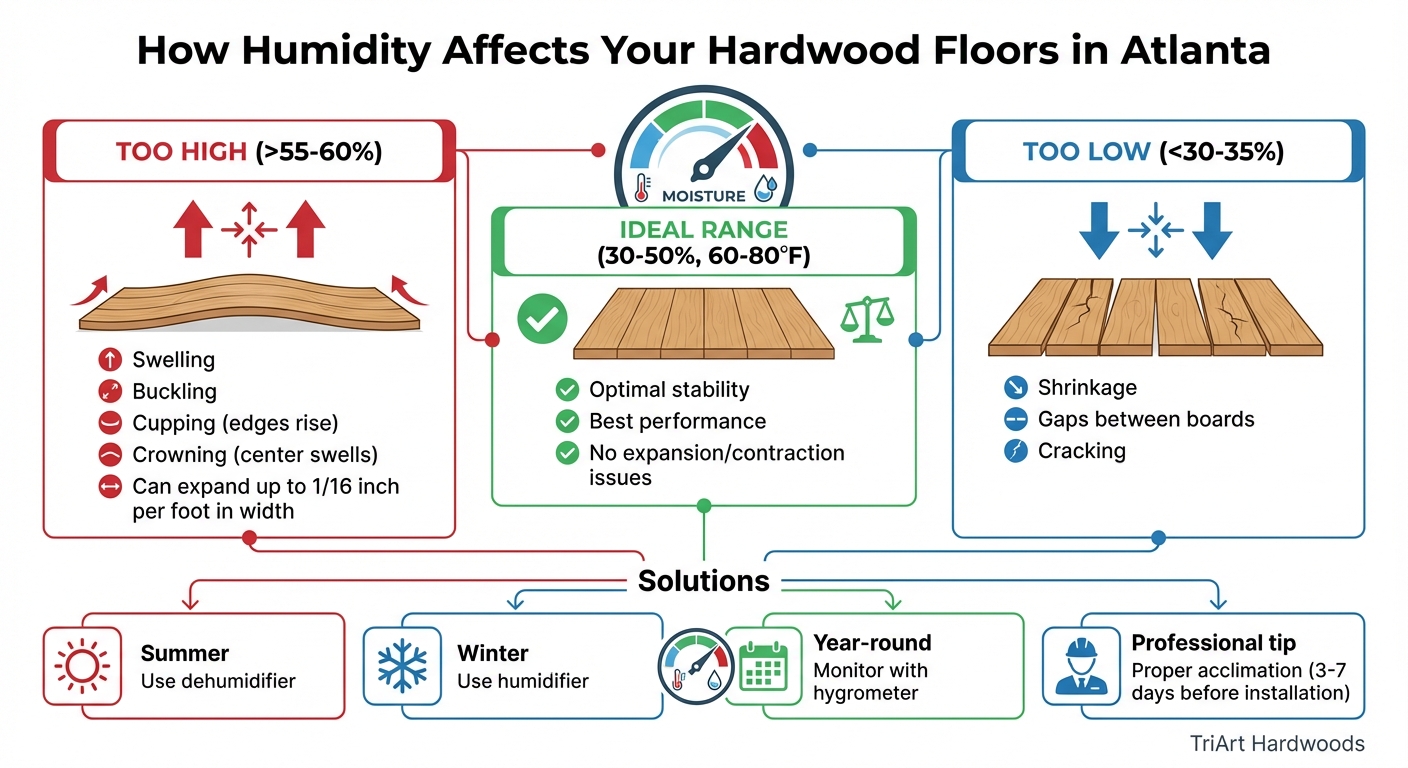
Atlanta Humidity Effects on Hardwood Floors: Ideal vs Problem Ranges
Atlanta’s humid subtropical climate creates unique challenges for hardwood flooring. With muggy summers followed by sudden cold snaps, wood floors face constant stress from fluctuating humidity and temperature levels. These changes aren’t just inconvenient – they can jeopardize your flooring if not managed properly during installation and maintenance.
Wood is naturally sensitive to moisture, absorbing or releasing it depending on the environment. When humidity climbs above 55–60%, hardwood planks swell, potentially leading to issues like expansion, buckling, cupping (where the edges rise higher than the center), or crowning (where the center swells more than the edges). On the other hand, during colder months or abrupt cold fronts, humidity can drop below 30–35%, causing the wood to contract. This contraction often results in shrinkage, gaps between boards, or even cracking. In extreme cases, solid hardwood planks may expand by as much as 1/16 inch per foot in width during high-humidity periods.
Humidity Control and Wood Acclimation
Managing humidity is crucial for hardwood flooring in Atlanta. Before installation, proper acclimation ensures the wood adjusts to its environment. This involves opening the cartons and cross-stacking planks with small wood spacers to allow air circulation. Additionally, running your HVAC system for at least five days beforehand stabilizes the indoor climate. Ideally, the relative humidity indoors should stay between 30% and 50%, with temperatures ranging from 60°F to 80°F.
"The acclimating process is more than anything, a waiting game. It basically means giving the hardwood planks the necessary time to adjust and adapt to the new environment."
– First Atlanta Flooring
TriArt Hardwoods incorporates these climate-specific practices to ensure your floors are ready to handle Atlanta’s conditions.
| Humidity Level | Potential Impact on Hardwood Floors |
|---|---|
| Above 55–60% | Swelling, buckling, cupping, or crowning |
| 30% to 50% | Ideal range for stability and performance |
| Below 30–35% | Shrinkage, gaps between boards, and cracking |
By following these acclimation steps, you can prepare your hardwood floors to withstand Atlanta’s shifting seasons.
Temperature Changes Throughout the Year
Beyond humidity, Atlanta’s seasonal temperature swings add another layer of complexity to maintaining hardwood floors. To address this, TriArt Hardwoods uses specific installation techniques, such as leaving precise expansion gaps around the room’s perimeter. These gaps allow wood to expand and contract naturally as temperatures fluctuate.
"What makes Atlanta particularly challenging for hardwood floors is our unique mix of extended humid periods followed by sudden cold fronts."
– Great American Floors
Proper subfloor preparation is equally important. Installing moisture barriers prevents water vapor from seeping up from below, reducing the risk of swelling during the humid summer months. For homes prone to significant humidity shifts, engineered hardwood is often recommended. Its layered construction provides better dimensional stability compared to solid wood.
To maintain the ideal 30% to 50% humidity range year-round, homeowners can use a hygrometer to monitor indoor conditions. Dehumidifiers are helpful during Atlanta’s humid summers, while humidifiers can counteract the dryness of winter. Careful monitoring after installation is just as critical as the initial preparation, ensuring that your hardwood floors remain durable through all of Atlanta’s weather changes.
Hardwood Floor Types Available from TriArt Hardwoods
Choosing the right flooring is especially important in Atlanta, where humidity and temperature can vary widely. TriArt Hardwoods offers three main hardwood flooring options – solid, engineered, and parquet – each tailored to handle these environmental challenges while meeting the unique needs of your home. Here’s a closer look at what each type brings to the table.
Solid Hardwood
Solid hardwood is crafted from a single piece of natural wood, typically 3/4 inch thick. Known for its classic appearance and long lifespan, this flooring can be sanded and refinished 5–7 times, ensuring it stays beautiful for decades.
However, installation requires nailing or stapling the planks to a plywood subfloor, making it unsuitable for basements or below-grade areas. While solid hardwood offers superior refinishing options, it is more prone to expanding and contracting with humidity changes compared to engineered alternatives. Popular wood species like White Oak, Hickory, and Maple provide varying levels of durability and moisture resistance.
Engineered Hardwood
Engineered hardwood combines a real wood veneer with multiple layers of plywood or fiberboard arranged in a cross-grain pattern.
"This layered, perpendicular construction is the secret to engineered hardwood’s stability… making the plank extremely dimensionally stable."
– First Atlanta Flooring
This design enhances resistance to warping, cupping, and buckling, making engineered hardwood an excellent choice for Atlanta’s challenging climate. It’s versatile enough for installation over concrete slabs, in basements, and even with hydronic radiant heating systems. Installation methods include glue-down, staple-down, or floating click-and-lock systems.
While engineered hardwood can be refinished 1–3 times depending on the veneer’s thickness, planks with a 3mm or thicker wear layer can be treated similarly to solid wood. Costs for materials typically range from $3 to $15 per square foot, with installation adding $3 to $10 per square foot. Atlanta resident Weronika Bartnik, who hired TriArt Hardwoods in June 2025 to install engineered flooring, praised the results, saying her new floors "came out perfect" and appreciated their guidance in selecting the best option for her home.
Parquet and Patterned Floors
For those looking to make a bold design statement, TriArt Hardwoods also specializes in custom parquet flooring. These floors feature intricate geometric patterns like herringbone, chevron, or basket weave, adding visual impact to upscale interiors. Achieving these designs requires precision and expertise, as consistent patterns depend on skilled craftsmanship. With NWFA certifications, TriArt Hardwoods’ team is equipped to handle these challenging installations with precision and care.
How TriArt Hardwoods Installs Hardwood Floors
In Atlanta, where humidity and temperature swings can wreak havoc on hardwood flooring, TriArt Hardwoods takes a careful, climate-conscious approach to installation. Getting the installation right is crucial – it’s the difference between floors that last for decades and floors that warp, squeak, or buckle in no time. Here’s how they handle the process.
Subfloor Preparation and Inspection
Before laying a single plank, the team thoroughly inspects the subfloor. They check for levelness, structural stability, and cleanliness. Any high spots are smoothed out, and low areas are filled to create a flat surface. Since Atlanta’s humidity can be a challenge, moisture testing is a key step. Wood subfloors must have a moisture content below 12%, while concrete should have a relative humidity of 75% or less.
For wood subfloors, the team secures them tightly to the floor joists to prevent squeaks and ensure stability. If the subfloor is concrete, they confirm it’s at least 60 days old before proceeding. Once the subfloor is ready, attention shifts to acclimating the wood and planning the layout.
Wood Acclimation and Layout Planning
To ensure the hardwood performs well over time, it needs to acclimate to the room’s environment. TriArt Hardwoods recommends storing the flooring in the installation room for 3 to 7 days. Solid hardwood typically requires 5 to 7 days, while engineered wood needs 2 to 3 days. During this acclimation period, the HVAC system should maintain normal living conditions – temperatures between 60°F and 80°F and relative humidity levels between 30% and 50% – for at least 5 days before installation.
Planks are cross-stacked with spacers to allow airflow, and moisture meters are used to confirm compatibility. For solid hardwood, the moisture content difference should stay within 2% to 4%, while engineered wood should have less than a 2% difference. Layout planning is also critical. Installers mix plank colors and lengths for a natural look, stagger end joints by 6 to 12 inches, and leave a ½-inch to ¾-inch expansion gap around the perimeter to accommodate wood movement. Once acclimated and planned, the installation method is selected based on your subfloor and flooring type.
Installation Methods
TriArt Hardwoods uses three main installation techniques, each tailored to specific subfloor types and hardwood styles:
- Nail-Down: Perfect for solid hardwood over plywood or OSB, this method creates a strong mechanical connection.
- Glue-Down: Ideal for engineered hardwood on concrete or wood subfloors, it provides stability and minimizes squeaks.
- Floating (Click-Lock): Best for engineered hardwood over concrete, tile, or wood, this system allows planks to lock together without being attached to the subfloor. It’s quicker to install and easier to repair.
| Installation Method | Best Subfloor Type | Recommended Wood Type | Key Benefit |
|---|---|---|---|
| Nail-Down | Plywood or OSB | Solid Hardwood | Strong connection; lower cost |
| Glue-Down | Concrete or Wood | Engineered Hardwood | Stable; reduces squeaking |
| Floating | Concrete, Tile, or Wood | Engineered (Click-Lock) | Easy repair; bridges imperfections |
The right method is determined during an in-home consultation. Factors like subfloor moisture levels and the type of hardwood you choose are carefully evaluated.
"Professional installation ensures that your hardwood floors are correctly installed from the start, preventing issues like buckling, gaps, and unevenness"
– TriArt Hardwoods
What Affects Hardwood Installation Costs in Atlanta
Hardwood installation costs in Atlanta depend on several factors, including the size of the space, the materials chosen, and the condition of the underlying surface. Homeowners in Atlanta typically spend between $1,560 and $4,871 on installation, with the average cost landing around $3,120.
Project Size and Material Costs
The size of the project is a major cost driver. Larger areas often benefit from lower per-square-foot rates, while smaller projects may face minimum fees.
Material choice plays a big role in pricing. Domestic hardwoods like oak, maple, and hickory cost between $8 and $14 per square foot installed. On the other hand, exotic woods, such as Brazilian cherry or walnut, can range from $15 to $20 or more per square foot. If you’re considering engineered hardwood, expect to pay $10 to $18 per square foot, while solid hardwood typically costs $10 to $22 per square foot.
Labor costs in Atlanta vary between $3 and $8 per square foot, depending on the installation method and the complexity of the layout. It’s also wise to budget for 10% extra material to account for cutting and waste.
Extra Services and Custom Work
Additional services can significantly influence your total costs. For instance, subfloor repairs or leveling – often necessary in older Atlanta homes – can add $3 to $12 per square foot. Removing old flooring ranges from $2 to $6 per square foot, with carpet removal being less expensive than tile.
Given Atlanta’s humid climate, many installations require moisture-protection underlayment, which costs $0.50 to $5.40 per square foot. If mold or water damage is found during the process, remediation expenses can climb to $10 to $25 per square foot. Custom designs, like herringbone or chevron patterns, increase labor costs by $2 to $4 per square foot. Meanwhile, stair installations can range widely, from $11 to $160 per step, depending on the complexity of the work.
TriArt Hardwoods simplifies the process with clear pricing, providing detailed in-home proposals and scheduling based on deposits.
"The floor you see isn’t the whole project – the condition underneath it is what drives cost. The best way to avoid surprises is to ask your vendor to price flooring as a full system: Demo, prep, install and finishing."
– Derek Shewmon, Co-founder, HOMEstretch
Next, learn how maintenance practices can protect your investment over time.
How to Maintain Your Hardwood Floors
Taking care of your hardwood floors isn’t just about keeping them clean – it’s about protecting your investment and ensuring they last for years to come. In Atlanta’s humid climate, a bit of extra attention can go a long way.
Cleaning and Daily Care
Start with the basics: dust daily using a microfiber mop or broom to capture dirt and debris. Vacuum twice a week, but make sure the vacuum is on the hardwood setting with the beater bar turned off to avoid scratches.
When it’s time to mop, stick to pH-neutral hardwood cleaners. Harsh chemicals can damage the finish, leaving the wood vulnerable to moisture. Avoid steam mops or overly wet cleaning tools, as they can cause warping or buckling. Instead, use a lightly dampened, well-wrung mop for a gentle clean.
For spills, act fast. Blot them immediately with a dry cloth rather than rubbing, which could push the liquid deeper into the wood. In high-traffic areas, lay down area rugs to minimize wear. Just steer clear of rugs with rubber or latex backing, as they can trap moisture and discolor the wood. To prevent scratches, add felt pads to furniture legs and replace them as they wear out.
Regular cleaning combined with smart preventative measures will keep your floors looking their best.
Protecting Floors from Moisture
Atlanta’s fluctuating humidity levels can be tough on hardwood floors. To keep them in top shape, aim to maintain indoor relative humidity between 30% and 50%. A dehumidifier during the sticky summer months and a humidifier in the dry winter can help stabilize conditions and prevent the wood from expanding, contracting, or cracking.
Place mats at exterior doors to catch moisture and dirt before they make it inside. Curtains or blinds can also help by reducing direct sunlight, which can fade and heat the wood. If you have pets, keep their nails trimmed to avoid scratches, and use waterproof mats under water bowls to prevent localized damage.
For long-term care, TriArt Hardwoods suggests professional recoating every 3 to 5 years. This refreshes the protective finish and enhances moisture resistance, ensuring your floors stay protected and beautiful for years to come.
Conclusion
Precision and local expertise are the keys to turning hardwood floor installations into enduring investments. In Atlanta, where the climate can pose unique challenges, choosing the right installer is essential. TriArt Hardwoods, with over 12 years of specialized experience, combines NWFA certification and a deep understanding of Atlanta’s conditions to deliver exceptional results.
From the first consultation to the final walk-through, their efficient process ensures quality and attention to detail, no matter the size of the project. This dedication reflects their unwavering commitment to delivering top-tier craftsmanship.
"We build a foundation for your home’s beauty."
- TriArt Hardwoods
With a 5.0-star rating from 115 verified reviews, TriArt Hardwoods has earned its reputation by prioritizing clear communication, meticulous craftsmanship, and even repairing damage caused by previous contractors. They don’t just install floors – they provide tailored, long-lasting solutions designed specifically for Atlanta’s unique environment and your home.
If you’re ready to elevate your space with stunning, durable hardwood floors, TriArt Hardwoods is here to help. Serving Alpharetta, Atlanta, Brookhaven, Buckhead, Dunwoody, Johns Creek, Kennesaw, Marietta, Milton, Roswell, Sandy Springs, Woodstock, and other areas across metro Atlanta, they’re ready to deliver climate-ready flooring solutions. Contact TriArt Hardwoods today to get started.
FAQs
How do I know if my home needs solid or engineered hardwood?
When choosing between solid and engineered hardwood for your flooring in Atlanta, it’s essential to factor in the city’s humid climate. Engineered hardwood handles humidity better, as it’s less likely to warp or expand, making it a dependable option. On the other hand, solid hardwood may be more affected by moisture but offers the advantage of being refinished multiple times. Think about your home’s conditions and long-term needs to determine the best fit for durable and beautiful flooring.
What indoor humidity should I maintain to prevent gaps or warping?
To avoid gaps or warping in hardwood floors, it’s important to keep indoor humidity levels between 35% and 55% relative humidity. This range helps stabilize the wood, preventing it from expanding or shrinking due to fluctuations in moisture.
How long will hardwood installation take in my Atlanta home?
Hardwood installation in Atlanta usually takes between 1 to 3 days for most projects. The exact timeframe depends on a couple of key factors, such as the size of the space and the complexity of the work. Larger areas or more detailed installations might extend the timeline a bit, but in general, homeowners can count on a fast and efficient process.


