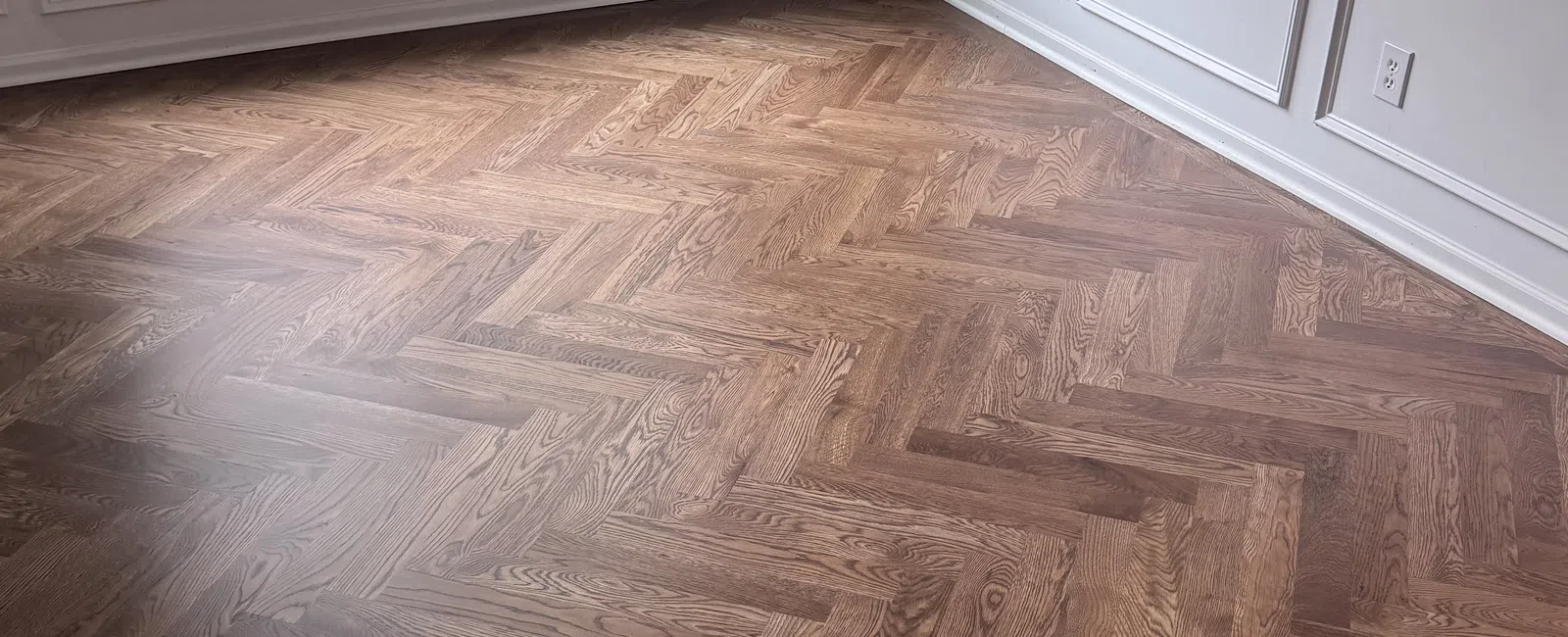
We refinish floors for a living, which means we see the end result of a decade of cleaning habits. The floors that hold up are not the ones that get cleaned most often. They are the ones cleaned with the right amount of water and the right product, on a routine that removes grit before it does damage.
Everything below comes down to two principles: get the grit off often, and keep the water to a minimum.
The Short Version
- Dust mop or vacuum two or three times a week with a microfiber dust mop or a vacuum with the beater bar switched off. This is the step that actually prevents scratching.
- Damp mop once a week with a pH-neutral hardwood cleaner on a microfiber flat mop. The floor should be dry to the touch within a minute.
- Deep clean two to four times a year depending on traffic.
- Never use vinegar, ammonia, bleach, oil soap, wax, or a steam mop.
If you do nothing else, do step one. Scratching on hardwood is caused by sand and grit being dragged across the finish, not by cleaning products. Removing it is worth more than any cleaner you can buy.
Daily and Weekly: The Maintenance Routine
Dry cleaning first, always
Use a microfiber dust mop, an electrostatic sweeper, or a vacuum with hard-floor settings. If you vacuum, confirm the beater bar or brush roll turns off. A spinning brush roll on hardwood does exactly what you would expect over time.
Focus on entryways and the traffic lanes running through them. Most of the grit in a house comes in on shoes and travels no more than fifteen feet before it gets deposited.
Then damp mop
Spray a pH-neutral hardwood cleaner onto the microfiber pad, or mist it lightly onto a small section of floor. Do not pour cleaner onto the floor and do not use a bucket. Work in the direction of the boards, in overlapping passes, flipping or swapping the pad when it looks dirty.
The test for whether you are using too much liquid: look behind you. If there is a visible wet sheen that lasts more than about thirty seconds, wring the pad out further.
How Often Each Area Needs Cleaning
| Area | Dry clean | Damp mop |
|---|---|---|
| Entryways and mudrooms | Daily | Weekly |
| Kitchen | Daily | Weekly |
| Main living areas | 2 to 3 times a week | Weekly to biweekly |
| Bedrooms and low-traffic rooms | Weekly | Monthly |
| Formal rooms rarely used | Every 2 weeks | Quarterly |
Deep Cleaning
Deep cleaning is for the film that builds up over months: cooking residue, body oils, product buildup, and the grime that a weekly damp mop does not lift. Two to four times a year is right for most homes.
- Clear the room and dust mop thoroughly, including under and behind furniture.
- Work in sections of roughly four by four feet rather than trying to do a whole room at once.
- Use a slightly more generous application of hardwood cleaner than you would weekly, but still no standing liquid.
- Let it sit briefly, around thirty seconds, to loosen the film.
- Agitate with a clean microfiber pad, not a scrub brush or abrasive pad.
- Wipe with a second, clean, barely damp pad to lift the residue rather than spreading it around.
- Dry the section before moving on.
If the floor still looks dull after a proper deep clean, the problem is not dirt. Either there is a residue layer from previous products, or the finish itself is worn. Both are covered below.
Our hardwood floor cleaning service handles the deep-clean end of this for homes where it has gotten away from them, including residue removal.
Cleaning by Floor Type
Prefinished hardwood
Prefinished floors have a factory-applied finish, usually aluminum oxide, that is harder and more chemically resistant than site-applied polyurethane. That makes them slightly more forgiving of cleaning products.
The catch is the beveled edges. Most prefinished flooring has a micro-bevel at each board edge, and those grooves collect grit and cleaner residue. Dust mop along the boards rather than across them so the pad follows the grooves instead of skipping over them, and pay attention to them during deep cleans.
Otherwise the routine is identical: dry clean often, damp mop weekly, pH-neutral cleaner, no standing water. Check your manufacturer's warranty, because many specify an approved cleaner by name and using something else can affect coverage.
Engineered hardwood
Clean engineered hardwood exactly like solid hardwood, with one difference: be even more disciplined about water. The core is plywood or HDF, and if moisture reaches it through a seam it swells and can delaminate the veneer from the core. That damage is not repairable. Solid wood that swells can often be sanded flat. Delaminated engineered cannot.
Old and unfinished floors
Floors with a worn-through finish, a wax finish, or no finish at all need a different approach, because there is no protective film and liquid goes straight into the wood.
Waxed floors should be cleaned dry and re-waxed, never wet mopped and never cleaned with a water-based polyurethane cleaner. Unfinished or badly worn floors should be dry cleaned only until they are refinished. If water drops soak in and darken the wood rather than beading on the surface, treat the floor as unfinished regardless of what it looked like originally.
Cleaning naturally
The honest answer here is that the popular natural recipes are worse for a wood floor than a commercial cleaner. Vinegar is acidic and degrades polyurethane. Oil soaps and olive-oil mixtures leave a residue that has to be chemically stripped before the floor can be recoated. Castile soap leaves a film.
If low-toxicity is the goal, look for a plant-based, pH-neutral hardwood cleaner with a recognized low-VOC certification rather than mixing something at home. Several manufacturers make one and they perform the same as the conventional versions.
What Not to Use
A few products come up again and again as things people reach for that quietly work against a hardwood finish:
- Vinegar, lemon juice, and any acidic cleaner
- Ammonia, bleach, and all-purpose sprays containing either
- Oil soaps and anything advertised as restoring shine
- Wax over polyurethane
- Steam mops
- Abrasive pads, powders, and scrub brushes
- A bucket and string mop, which is a water-delivery problem more than a product problem
Cleaning That Will Not Fix the Problem
There are a few situations where no amount of cleaning helps, and continuing to try just wastes a weekend. Dull traffic lanes that stay dull no matter how carefully you clean them mean the finish is worn through in those paths specifically, and the fix is a screen and recoat, or a full refinish if liquid has already reached the wood. A cloudy haze across a whole room is usually residue left behind by an oil soap or shine restorer, which needs chemical stripping rather than another round of cleaning to come off. Dark or grey staining that will not lift is a different problem entirely: the color is in the wood itself rather than sitting on top of it, which no cleaner, however strong, is going to reach.
Prevention Beats Cleaning
Doormats outside and washable rugs inside every exterior door do more than any other single change, since most of what damages a finish walks in on shoes before it ever reaches a mop. Felt pads under every furniture leg matter too, though they need checking about once a year, since they collect grit and eventually fall off without anyone noticing. Shoes off, or at least heels and anything with grit caught in the tread, cuts down on what gets tracked through the house in the first place. Indoor humidity kept roughly between 35 and 55 percent year round limits the seasonal expansion and contraction that opens gaps and stresses a finish. Trimmed pet nails are worth the effort too, since nails are a top-three cause of visible surface scratching. And spills wiped immediately, rather than once you finish what you are doing, rarely leave a mark at all.
Dawn, Mr. Clean, and Other Household Cleaners
Dish soap and all-purpose cleaners are not built for a polyurethane finish, and the two questions come up often enough on their own to answer directly. Dawn and similar dish soaps leave a soapy film behind that dulls the finish over time and builds up with repeated use, and that residue has to be stripped before the floor can be recoated. Mr. Clean and other all-purpose sprays cause the same problem for the same reason: they are formulated to cut through grease and grime, not to sit safely on a wood finish, and most contain either ammonia or a surfactant that leaves residue behind. A dedicated pH-neutral hardwood cleaner costs a few dollars and avoids all of it.
Cleaning a Neglected or Very Dirty Floor
A floor that has gone months without a real cleaning needs more patience than product. Start with a thorough dry clean, since a heavy layer of grit will turn any wet pass into light sanding if you skip it. Then deep clean in small sections, using a bit more cleaner than usual and letting it dwell for closer to a minute before wiping, rather than reaching for a stronger chemical. Expect to go over stubborn areas two or three times rather than scrubbing harder on the first pass, since scrubbing is what leaves fine scratches in a finish that a second, gentler pass will not. If the floor is still dull after two full deep cleans, the issue has moved past dirt and into residue or a worn finish, both covered above.
Can You Clean Hardwood Floors With Bleach
No. Bleach discolors wood, degrades polyurethane, and leaves a residue behind, without doing anything a proper hardwood cleaner does not already do better. It is not a shortcut for mold or staining either, since it does not penetrate far enough into the wood to reach either problem.
When Cleaning Stops Being the Answer
If the floors stay dull no matter what you do, the finish is worn rather than dirty, and that is a refinishing job. TriArt Hardwoods deep cleans, recoats, and refinishes hardwood across Atlanta, Johns Creek, and Sandy Springs. See our cleaning service, our refinishing service, or get in touch.