

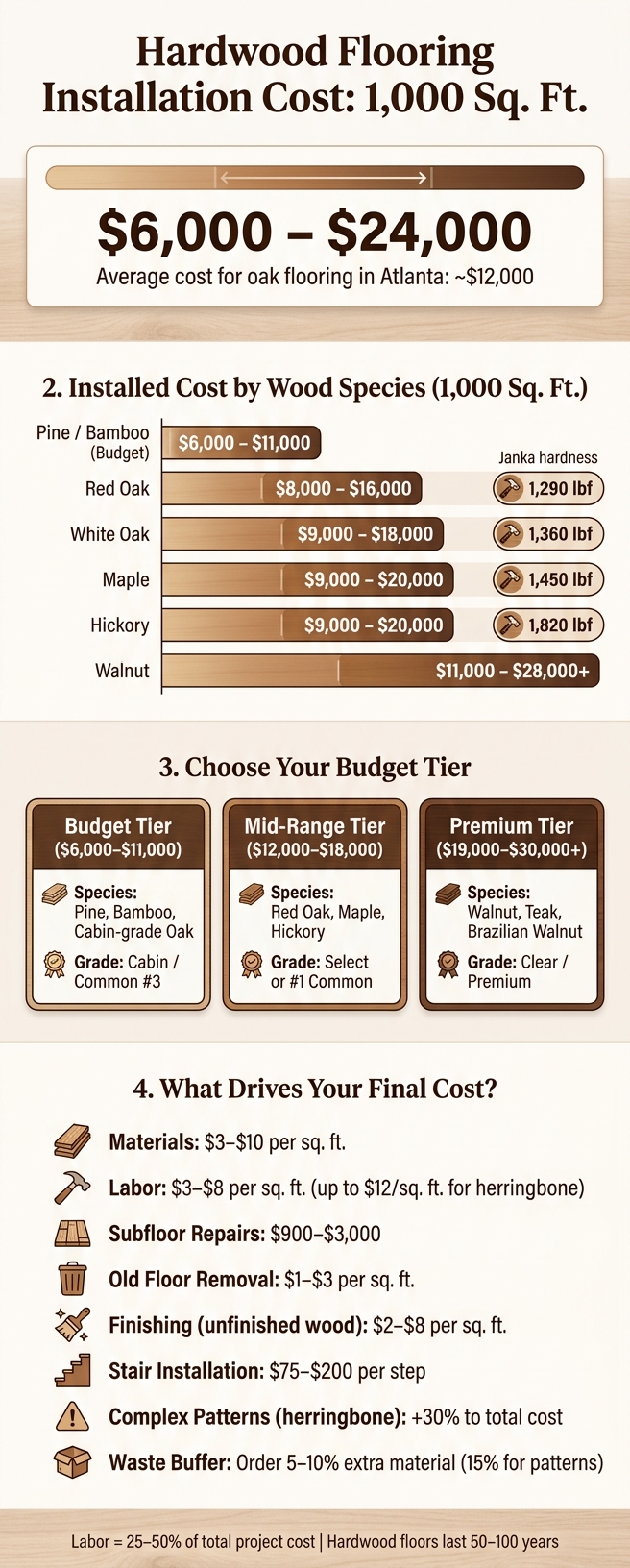
Installing hardwood flooring for 1,000 square feet typically costs $6,000 to $24,000. Prices vary based on material type, labor, and additional services like subfloor preparation or finishing. Here’s a quick breakdown:
- Material Costs: $3–$10 per sq. ft. for wood species like oak, maple, or hickory.
- Solid hardwood: $11,000–$25,000 (installed)
- Engineered hardwood: $9,000–$20,000 (installed)
- Labor Costs: $3–$8 per sq. ft., depending on installation method (nail-down, glue-down, or floating).
- Extra Costs: Subfloor repairs ($900–$3,000), old floor removal ($1–$3 per sq. ft.), and finishing ($2–$8 per sq. ft.).
For oak flooring in Atlanta, expect to pay $7,500–$18,000, averaging around $12,000. Complex patterns like herringbone or stair installations can increase costs by 30% or more. Always plan for 5–10% extra material for waste and get detailed quotes to avoid surprises.
Hardwood Flooring Cost Breakdown: 1,000 Sq. Ft. Installation Guide
How Much Does Hardwood Flooring Cost? (Full Price Breakdown)
sbb-itb-9f8f869
Main Cost Factors for a 1,000 Square Foot Hardwood Flooring Project
When budgeting for a 1,000 sq. ft. hardwood flooring project, your costs will primarily come from three areas: materials, labor, and additional services like subfloor preparation and finishing. Let’s break these down to help you understand where your money is going and what to expect.
Material Costs: Solid vs. Engineered Hardwood
Your first major decision is choosing between solid hardwood and engineered hardwood. Solid hardwood, carved from a single piece of wood, typically costs $5,000–$15,000 in materials for 1,000 sq. ft. Add installation, and the total ranges from $11,000–$25,000. Engineered hardwood is a more budget-friendly option, priced at $4,000–$12,000 for materials, or $9,000–$20,000 installed.
The difference isn’t just price. Solid hardwood is known for its durability and ability to be refinished multiple times, making it a long-term investment. Engineered hardwood, while less expensive, has a shorter lifespan and fewer refinishing cycles. However, it’s better suited for areas prone to moisture, such as basements or rooms with concrete subfloors, where solid wood might warp or buckle.
"Solid wood costs more, but it lasts longer and can be refinished multiple times. Engineered wood costs less and can be installed below grade." – Angi
Once you’ve chosen the material, the next big factor is labor, which varies based on installation methods and project complexity.
Labor Costs: Installation Methods and Project Complexity
Labor costs depend heavily on how the flooring is installed. Floating and click-lock installations are quicker and more affordable, often used for engineered hardwood. Glue-down methods are moderately priced and work well for engineered wood over concrete, while nail-down installations – the standard for solid hardwood – demand more time and expertise. If your project involves intricate patterns like herringbone, labor costs can climb to $12 per sq. ft., adding about 30% more to your budget compared to a straightforward installation.
| Installation Type | Labor Complexity | Best For |
|---|---|---|
| Floating / Click-Lock | Low | Engineered hardwood, DIY-friendly |
| Glue-Down | Moderate | Engineered wood over concrete |
| Nail-Down | High | Solid hardwood over wood subfloor |
| Herringbone / Custom Pattern | Very High | Any species, decorative designs |
Beyond installation, other factors like subfloor preparation and finishing can also impact your overall expenses.
Extra Costs: Subfloor Prep, Finishing, and Old Floor Removal
Additional services can significantly add to your budget. For example, subfloor repairs – like leveling or moisture treatment – can cost anywhere from $900–$3,000. If floor joists are damaged, repairs might run $40–$60 per sq. ft., with extensive fixes costing up to $5,000.
Removing your current flooring is another expense to plan for. Carpet removal costs around $1–$3 per sq. ft., while removing glued-down hardwood or tile is more labor-intensive and expensive. Finishing is also a factor: prefinished boards cost more upfront but save on labor, while unfinished wood requires on-site sanding, staining, and sealing, adding $2–$8 per sq. ft. in labor costs.
Want to save money? Consider handling tasks like moving furniture or removing old carpet yourself. Professionals typically charge $60–$120 per hour for these services. Small efforts like these can make a noticeable difference in your final bill.
Cost Breakdown by Hardwood Species
Choosing the right hardwood species is a big decision – it impacts both the look of your space and its long-term value. Here’s a breakdown of costs for some of the most popular hardwood options for a 1,000 sq. ft. installation.
Oak: Red and White
Oak is a favorite in many U.S. homes because of its durability, availability, and versatility. Red oak is the more budget-friendly option, with material costs ranging from $2–$11 per sq. ft. This means a 1,000 sq. ft. project would cost between $8,000 and $16,000 installed. Its warm, reddish hue and pronounced grain pattern are great for hiding minor wear and tear over time.
White oak, on the other hand, is slightly pricier at $4–$12 per sq. ft. for materials. Its higher cost is due to strong demand and its use in industries like barrel-making and shipbuilding. White oak’s nonporous structure makes it a smart choice for kitchens or areas with higher humidity. Its cooler, more neutral tones also pair well with modern or Scandinavian-inspired designs.
"If you’re planning on darker stains or trending neutral finishes, White Oak often provides greater flexibility." – Hardwoods4Less
White oak has a Janka rating of 1,360 lbf, slightly higher than red oak’s 1,290 lbf, though the difference is minimal for everyday use. Both options let you weigh upfront costs against durability and style.
Next up, let’s look at maple and hickory – two species known for their toughness.
Maple and Hickory
If you need flooring that can withstand heavy foot traffic, pets, or kids, maple and hickory are excellent choices. Maple has a Janka hardness of 1,450 lbf and features a subtle, light grain that works well in contemporary spaces. Hickory, the hardest of the common domestic hardwoods with a Janka rating of 1,820 lbf, offers a bold, rustic appearance with dramatic color variations – perfect for a natural, lived-in vibe.
| Species | Janka Rating | Material Cost (per sq. ft.) | Best For |
|---|---|---|---|
| Maple | 1,450 lbf | $3–$15 | Contemporary, high-traffic areas |
| Hickory | 1,820 lbf | $3–$14 | Rustic look, maximum durability |
For a 1,000 sq. ft. installation, total costs range from $9,000 to $20,000 for both maple and hickory. These species strike a solid balance between cost and durability, making them ideal for active households.
Walnut: A Higher-End Option
If you’re after a more luxurious look, walnut might be the way to go. Material costs for walnut start at $5 per sq. ft. and can climb to $20 per sq. ft. for imported or Brazilian varieties. This puts the total installed cost for 1,000 sq. ft. at $11,000–$28,000 or more. Walnut’s rich, dark tones and fine grain give it an upscale aesthetic that’s hard to match.
Brazilian walnut (Ipe) stands out for its resistance to fire, insects, fungi, and dents. While it comes with a higher price tag, walnut’s combination of striking visuals and long-term durability makes it a popular choice for living rooms, home offices, and high-end renovations where style is a priority.
How to Estimate Your 1,000 Square Foot Installation Budget
Measuring Your Space and Factoring in Waste
Start by measuring each room separately – multiply the length by the width to calculate the square footage, then add those totals together. Once you have the overall square footage, order 5%–10% extra material to cover waste, cuts, and tricky corners. If you’re planning a complex pattern like herringbone, increase this to 15%, which can raise costs by about 30%. Don’t forget smaller items like nails, moldings, and transition strips. With these numbers, you’re ready to align your needs with a realistic budget.
Budget, Mid-Range, and Premium Installation Scenarios
Once you’ve calculated your material needs, you can categorize your project into one of these spending tiers:
| Scenario | Common Species | Wood Grade | Estimated Total |
|---|---|---|---|
| Budget | Pine, Bamboo, Cabin-grade Oak | Cabin/Common #3 | $6,000–$11,000 |
| Mid-Range | Red Oak, Maple, Hickory | Select or #1 Common | $12,000–$18,000 |
| Premium | Walnut, Teak, Brazilian Walnut | Clear/Premium | $19,000–$30,000+ |
Labor typically makes up 25% to 50% of the total cost, with rates averaging $3 to $6 per square foot. You can save by handling tasks like moving furniture yourself – professionals may charge $60 to $120 per hour for this service.
"When you are dealing with a reputable company, you won’t get hidden costs. They tend to charge a bit more, but they cover everything needed." – David Goodell, Founder, Woodworking Clarity
Keep in mind that additional project-specific factors can influence your final costs.
Project-Specific Factors That Affect Your Budget
Once you’ve set your budget based on square footage and standard pricing tiers, consider unique elements of your project that might raise costs. Subfloor condition is a major factor. If your subfloor is uneven, water-damaged, or compromised, repairs or replacement can add anywhere from $428 to $2,978 to your total. Joist repairs, if needed, are even pricier at $40 to $60 per square foot.
"When your floorboards start to creak more than usual, are not even, or doors begin to stick, you know there must be a problem either with your subflooring or floor joists." – David Goodell, Founder, Woodworking Clarity
Room layout also plays a role. Angled spaces, built-ins, closets, or fireplaces require more detailed cuts, which increases labor time and material waste. If you’re replacing old flooring, account for removal costs: carpet removal typically runs $0.70 to $1.60 per square foot, while glued-down tile or hardwood can cost $1.50 to $3.50 per square foot. Lastly, factor in 1–2 weeks for hardwood acclimation to avoid future issues like warping or gaps.
How Installation Methods and Add-On Services Affect Total Cost
Nail-Down, Glue-Down, and Floating Installations Compared
Nail-down installation, often used for solid hardwood over wood subfloors, is a reliable but labor-intensive method, with labor costs ranging from $3 to $9 per square foot. Glue-down installation, suitable for engineered or solid wood over concrete, comes with the added expense of adhesive, increasing the overall cost. Floating installations, on the other hand, are the most budget-friendly option. These planks click together without needing to be fastened to the subfloor, making the process quicker and ideal for DIY enthusiasts. This method works particularly well with engineered wood and is a practical choice for moisture-prone areas like basements. However, floating floors may not feel as solid underfoot as nailed or glued options.
"Unless you have thousands of dollars to risk, always use a professional." – David Goodell, Founder, Woodworking Clarity
In addition to the basic installation types, design preferences and structural elements can further influence your overall costs.
Custom Patterns, Stairs, and Repairs: What They Add to the Cost
Beyond the basic installation methods, design elements and structural challenges can significantly impact your budget. For instance, custom patterns like herringbone can increase the total installation cost by about 30% due to the additional material waste, precision cuts, and labor required. True parquet flooring, known for its intricate designs, can range from $13 to $40 per square foot.
Stair installation is another factor often excluded from standard quotes. Each step requires precise cuts for treads and risers, adding to the complexity.
"Continuing hardwood treads and risers on staircases takes more time and materials. This is rarely accounted for up-front." – Stephanie Minasian-Koncewicz, Author
The cost for stair installation can range from $75 to $200 per step, meaning a standard 13–15 step staircase could add $975 to $3,000 to your total.
Additional Services Offered by TriArt Hardwoods
TriArt Hardwoods provides services designed to protect and extend the life of your hardwood flooring. Refinishing is one of the most cost-effective ways to maintain your floors, with costs between $3 and $8 per square foot – a fraction of what it would cost to replace the flooring. Solid hardwood can be refinished up to 10 times, allowing a well-maintained floor to last as long as a century. Experts often recommend refinishing every 7 to 10 years to address deep scratches and surface wear.
TriArt also offers water-damage restoration, a critical service for mitigating the effects of moisture on both the wood and subfloor. Their deep cleaning service helps maintain your floor’s finish between refinishing cycles. Additionally, their hardwood stairs and handrails service ensures a cohesive look throughout your home. For spaces with persistent moisture issues – such as bathrooms, laundry areas, or basements – TriArt installs waterproof flooring solutions, providing a practical alternative to traditional hardwood.
Conclusion: Planning Your Hardwood Flooring Budget
Installing hardwood flooring for a 1,000 sq. ft. space typically costs between $6,000 and $24,000, offering excellent returns on investment. New installations can recover up to 118%, while refinishing projects may recover as much as 147% of their cost.
Several factors influence these costs, including your choice of materials, the complexity of labor, and the condition of your subfloor. To keep expenses in check, consider practical options like prefinished boards, handling furniture removal yourself, or opting for simpler installation methods like nail-down over intricate patterns like herringbone. However, unexpected issues – like rotted joists or stair installations – can increase the total cost. That’s where experienced professionals come in. Their expertise helps identify structural problems early, ensures proper moisture management and acclimation, and minimizes wasted materials through precise techniques. If you’re in the Atlanta area, companies like TriArt Hardwoods provide the skilled craftsmanship needed for everything from standard installations to more complex repairs and refinishing.
To protect your investment, gather at least three detailed written estimates, verify contractor credentials, and plan for a 10%–20% material buffer to account for waste and cuts. By combining these steps with earlier planning – like measuring your space, estimating waste, and understanding labor options – you can align your budget with your renovation goals. When installed properly, hardwood floors have an impressive lifespan of 50 to 100 years, making the upfront investment a decision you’re unlikely to regret.
FAQs
What’s the fastest way to get an accurate quote for 1,000 sq. ft.?
The fastest way to get an accurate estimate for 1,000 sq. ft. of hardwood flooring is to reach out to a professional flooring specialist or use an online estimate tool. By sharing details like the room size, type of flooring, and your specific preferences, you can receive a personalized quote. Local contractors or flooring retailers can also visit your space to evaluate it and provide precise pricing based on the materials you choose and the installation requirements.
Which is better for my home: solid or engineered hardwood?
Both solid hardwood and engineered hardwood are excellent real wood flooring options that bring durability and style to your home.
Solid hardwood stands out for its genuine feel, impressive longevity, and the ability to be refinished multiple times. It’s a great pick for spaces with stable, dry conditions where its timeless appeal can truly shine.
On the other hand, engineered hardwood is designed to handle moisture better, offers easier installation, and often comes in wider planks, making it a practical choice for areas where humidity or temperature changes are a concern.
The ideal option depends on your specific needs and the environment of your home. Each type has its strengths, so consider what works best for your space.
What hidden costs should I budget for beyond materials and labor?
When planning your flooring project, don’t forget to account for hidden expenses. These can include the cost of removing and disposing of your old flooring, repairing and leveling the subfloor, and purchasing trim, moldings, and transitions, which typically run about $2–$5 per linear foot. Additionally, if you don’t already own the necessary tools, you may need to set aside some funds for tool rentals to get the job done right.


