

The right hardwood flooring for commercial spaces depends on durability, maintenance needs, cost, and design preferences. High-traffic areas demand tough materials, while aesthetics and ease of care are also key factors. Here’s a quick breakdown:
- Oak: Durable, versatile, and stain-friendly; works well in lobbies, offices, and retail spaces.
- Maple: Dense and smooth, ideal for gyms and upscale offices, but shows scratches more easily.
- Hickory: One of the hardest domestic woods, perfect for spaces needing dent resistance, like showrooms or hotels.
- Engineered Hardwood: Best for moisture-prone areas or concrete subfloors, offering stability and durability.
Quick Comparison
| Type | Best For | Durability | Cost | Maintenance | Aesthetic Appeal |
|---|---|---|---|---|---|
| Oak | Lobbies, offices, retail spaces | High | $4–$8/sq. ft. | Low | Stain-friendly, versatile for various styles |
| Maple | Gyms, studios, offices | Very high | $5–$9/sq. ft. | Moderate | Light tone, sleek, modern |
| Hickory | Showrooms, hotels, retail spaces | Superior | $6–$10/sq. ft. | Moderate | Bold, rustic grain patterns |
| Engineered Wood | Moisture-prone areas, concrete | High | $3–$13+/sq. ft. | Easy | Polished, seamless finish |
Key Takeaway: Choose based on your space’s foot traffic, moisture levels, and design goals. Oak and engineered hardwood are versatile choices for most commercial spaces, while maple and hickory shine in specific high-demand settings.
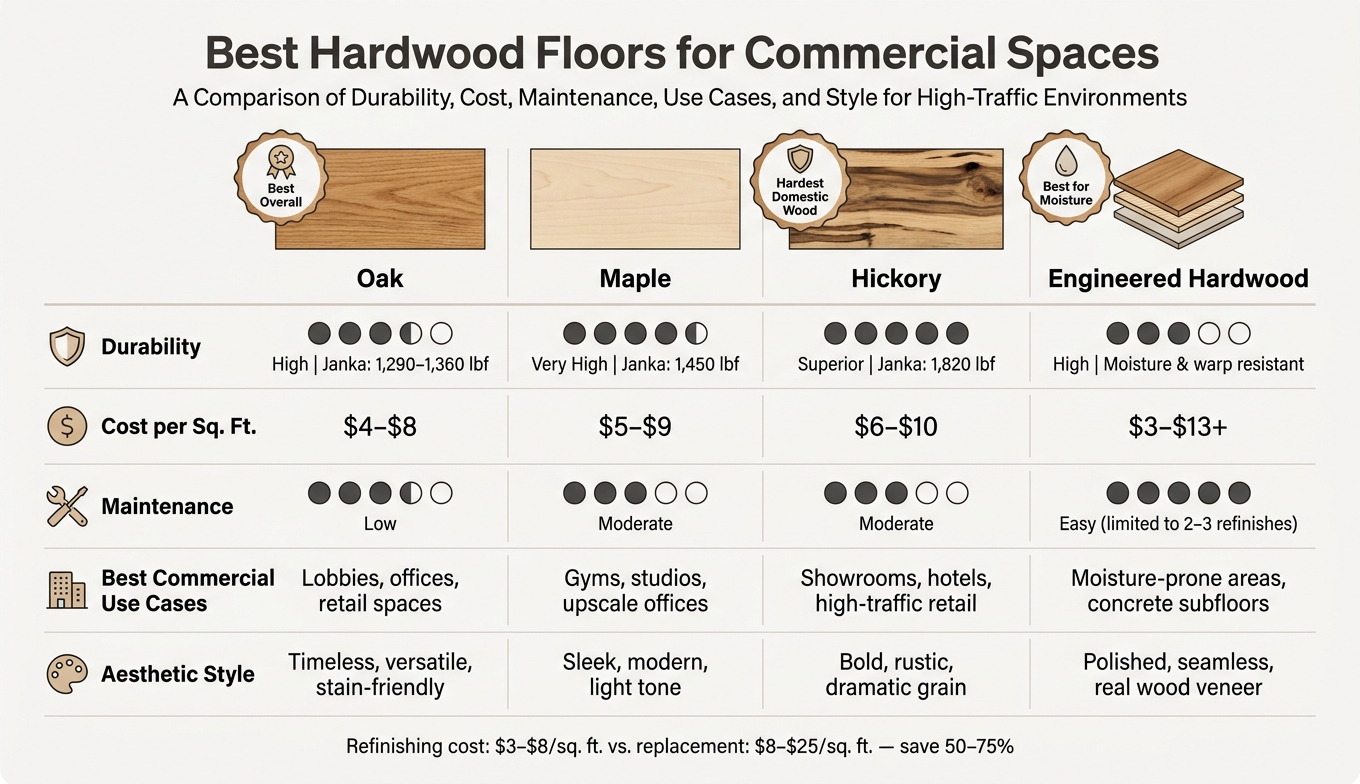
Best Hardwood Floors for Commercial Spaces: Side-by-Side Comparison
What is the Most Durable Hardwood Floor Species? | City Floor Supply
sbb-itb-9f8f869
1. Oak
Oak is a solid option for commercial flooring, known for its ability to handle heavy foot traffic and resist the kind of wear and tear that softer woods can’t endure. As Anthology Woods explains:
"Species like oak and teak are popular choices due to their ability to withstand heavy foot traffic and resist dents and scratches."
Durability
White Oak stands out as a hardwood specifically rated for commercial applications. Its high Janka rating highlights its impressive resistance to dents, making it an ideal choice for high-traffic areas like lobbies, offices, retail spaces, and hospitality venues. For example, in July 2023, the Virgin Hotel in Las Vegas installed Fumed European Fletcher Oak flooring to meet the demands of a bustling hospitality environment.
For spaces with concrete subfloors or below-grade installations, engineered oak is often the better choice. Thanks to its plywood core, it handles humidity fluctuations better than solid wood, resisting warping, swelling, or shrinking. While solid oak can be sanded up to 10 times, engineered oak with a thick wear layer can support about two refinishes, significantly extending its lifespan.
This durability also makes oak easy to maintain, reducing the effort required to keep it looking great.
Maintenance
Oak’s durability is matched by its low-maintenance needs, which is a big plus for busy commercial spaces. Regular care involves dry dusting or vacuuming, paired with occasional damp mopping using a pH-neutral, hardwood-safe cleaner. For finishes, aluminum oxide coatings are a good fit for retail spaces due to their hardness, while oil-based finishes are more practical in settings where localized plank repairs might be needed.
Opting for a matte or low-sheen finish is smart for high-traffic areas, as it hides everyday wear better than high-gloss finishes. Adding walk-off mats at entrances and felt pads under furniture legs can also help protect the floor between cleanings.
Cost-Effectiveness
Oak offers great long-term value. While its initial cost is higher than options like vinyl or laminate, its ability to be refinished instead of replaced makes it a more economical choice over time. Engineered oak is often less expensive than solid oak of the same species, and pre-finished planks can further reduce costs, as factory-applied finishes tend to last longer under heavy use compared to site-applied finishes.
Aesthetic Appeal
Beyond its practical benefits, oak brings a lot to the table in terms of design. Its versatility allows for a range of styles, from light tones that make spaces feel open and airy to darker stains that create a more formal, sophisticated atmosphere. White Oak, in particular, is known for being stain-friendly, meaning it absorbs color evenly and predictably – a huge advantage when trying to match a specific design palette.
This combination of durability, easy maintenance, cost efficiency, and aesthetic flexibility makes oak a standout choice for commercial flooring.
2. Maple
Maple is a standout choice for high-traffic commercial spaces. Its impressive density and hardness make it a go-to option for upscale retail stores, boutiques, and professional offices. Many commercial-grade engineered maple products feature a durable wear layer of up to 0.16 inches (4 mm) and come with lifetime structural warranties, ensuring long-term reliability. Let’s break down how maple performs in durability, maintenance, cost, and design.
Durability
Maple is built to handle the challenges of busy commercial environments. Its ability to be sanded and refinished multiple times over its lifespan means it can endure years of heavy use. With proper maintenance, maple floors can last as long as the building itself. For spaces with concrete subfloors or areas prone to moisture, engineered maple provides extra stability without compromising its sturdy wear layer.
Maintenance
Keeping maple floors in top condition is straightforward but requires consistent care. Daily sweeping and weekly vacuuming help prevent scratches caused by fine grit. To extend the time between full refinishes, a professional "clean and coat" service – costing around $1.50 per square foot – can be applied every few years. This service can delay the need for a full refinishing by 20 to 30 years. Adding felt pads to furniture and placing walk-off mats at entry points further protects the floor’s finish.
Cost-Effectiveness
While maple may have a higher upfront cost compared to some alternatives, its long-term value is undeniable. Refinishing an existing maple floor costs approximately $3 to $8 per square foot, significantly less than the $8 to $25 per square foot required for a new installation. That’s a savings of 50% to 75% on replacement costs. Additionally, the IRS classifies hardwood flooring as a structural improvement with a 27.5-year depreciation life, offering a tax advantage for commercial and rental properties.
Aesthetic Appeal
Maple’s clean and timeless look makes it a versatile choice for various commercial interiors. Its naturally light tone enhances brightness and creates the illusion of larger spaces, making it especially suitable for smaller layouts.
3. Hickory
Hickory stands out as one of the hardest domestic hardwoods, making it an excellent choice for high-traffic commercial spaces like gyms, retail showrooms, and boutique hotel lobbies. Its exceptional resistance to dents makes it a practical and durable flooring option.
Durability
According to Tiffany Allegro, Owner of Allegro Custom Floors:
"Hickory – one of the hardest domestic woods, highly resistant to denting."
This toughness means hickory can handle heavy furniture, rolling equipment, and constant foot traffic without showing significant wear. However, it is 11% less stable than Red Oak, which means it can be more susceptible to cupping or warping when exposed to humidity changes. For installations in areas like concrete slabs where moisture may be a concern, engineered hickory is a smarter choice. It offers the same hardness on the surface but with better resistance to moisture-related issues.
Maintenance
To keep hickory floors looking their best, consistent care is necessary. While tough, it still requires regular maintenance:
- Daily dusting prevents grit from scratching the surface.
- Use pH-neutral hardwood cleaners to maintain the finish without causing damage.
- Add walk-off mats at entrances and furniture pads under heavy items to reduce wear.
For professional upkeep, water-based coatings like Bona Traffic or UV-cured polyurethane are highly recommended for added protection.
Cost-Effectiveness
Hickory also offers long-term value. Refinishing costs range from $3 to $8 per square foot, which is significantly less than the $8 to $25 per square foot required for a full replacement – potentially saving 50% to 75%. Repairs typically cost between $6 and $14 per square foot, and applying a maintenance coat every few years (around $1.50 per square foot) helps protect the finish. Plus, under IRS guidelines, hickory flooring qualifies as a structural improvement and depreciates over 27.5 years.
Aesthetic Appeal
Hickory’s bold grain pattern and high-contrast appearance make it a showstopper. It works beautifully in spaces like lobbies or open retail areas, especially those with rustic, natural, or industrial design themes. However, its "busy" grain may feel overwhelming in rooms with intricate cabinetry or heavily patterned decor.
Hickory combines durability, cost-efficiency, and striking aesthetics, making it a popular choice for commercial spaces that need to balance practicality with style.
4. Engineered Hardwood
Engineered hardwood is often a practical choice for commercial spaces, especially when solid wood isn’t feasible. It combines a genuine hardwood veneer with a multi-layer plywood or HDF core, making it well-suited for demanding environments.
Durability
Thanks to its layered construction, engineered hardwood resists warping, swelling, and cupping, even in areas with fluctuating humidity. Factory-applied finishes, like aluminum oxide or UV-cured polyurethane, provide excellent scratch resistance and extend the floor’s lifespan. However, engineered hardwood typically supports only 2–3 refinishing cycles.
Tiffany Allegro, Owner of Allegro Custom Floors, highlights its advantages:
"In ground-level installations or over concrete slabs – common in commercial buildings – engineered hardwood is typically the better choice due to its structural resilience."
Nydree Flooring adds:
"Factory finishes tend to last much longer than those applied by the installer, so while your engineered wood floor may not be able to be refinished 10 times, it also likely won’t require refinishing as many times."
While durable, these floors still require consistent care.
Maintenance
Daily dry dusting prevents grit from scratching the surface, while pH-neutral cleaners and light damp mopping help preserve the finish. In spaces with inconsistent HVAC conditions, a dehumidifier can help maintain stability. Adding walk-off mats at entrances and furniture pads under heavy fixtures further reduces wear. Prefinished planks eliminate the need for on-site sanding or finishing, saving time during commercial renovations.
Cost-Effectiveness
Engineered hardwood offers a balance of durability and manageable upkeep. Installation costs range from $7 to $20 per square foot, depending on material quality and labor. Material costs typically fall into three categories:
| Tier | Cost per Sq. Ft. | Best For |
|---|---|---|
| Low-end | $3–$5 | Low-traffic areas, thinner veneer |
| Mid-range | $5–$8 | Balanced durability and value |
| High-end | $8–$13+ | Heavy traffic, thick wear layer |
Labor adds another $3–$8 per square foot. With proper care, these floors can last 25 to 50 years.
Aesthetic Appeal
Engineered hardwood enhances commercial spaces with its clean, polished look. Unlike solid wood, it requires smaller expansion gaps, meaning bulky baseboard moldings aren’t needed. This creates a seamless finish, ideal for retail, hospitality, and office settings. Popular species include oak ($4–$8/sq. ft.), maple ($5–$9/sq. ft.), and hickory ($6–$10/sq. ft.). For high-traffic areas, matte or low-sheen finishes are recommended, as they better disguise scuffs and everyday wear.
Pros and Cons
Let’s break down the trade-offs of different hardwood options for commercial spaces. The table below highlights key features to help you make an informed decision.
| Oak | Maple | Hickory | Engineered Hardwood | |
|---|---|---|---|---|
| Durability | High (Janka: 1,290–1,360 lbf); handles moderate-to-heavy traffic well | Very high (Janka: 1,450 lbf); ideal for high-wear areas like fitness studios | Superior (Janka: 1,820 lbf); excellent dent resistance among domestic woods | High; resists moisture and warping, especially on concrete subfloors |
| Maintenance | Simple; open grain conceals scratches and takes stains easily for touch-ups | Moderate; dense surface shows scratches more on darker finishes | Low; extreme hardness resists damage, though refinishing is more labor-intensive | Easy; daily care is simple, but refinishing is limited to 2–3 cycles |
| Cost-Effectiveness | Budget-friendly at $4–$8 per sq. ft.; refinishing costs $3–$5 per sq. ft. | Mid-range at $5–$9 per sq. ft.; refinishing runs $6–$8 per sq. ft. | Mid-range at $6–$10 per sq. ft.; higher upfront costs but fewer replacements needed | Variable at $3–$13+ per sq. ft.; faster installation saves on labor costs |
| Aesthetic Appeal | Timeless, with a bold grain; works with various stains and holds color well over time | Sleek and modern with a uniform look; may yellow with prolonged UV exposure | Rustic and bold with dramatic grain patterns; adds character to industrial spaces | Mimics solid wood with a real wood veneer; provides a seamless, polished finish |
This comparison highlights the strengths and trade-offs of each option to fit different needs.
Oak stands out as a practical choice, thanks to its affordability, ease of installation, and versatility with stains. Maple is perfect for high-traffic areas like gyms, where its smooth, dense surface performs well under heavy use. Hickory, with its unmatched dent resistance, is great for spaces requiring extra durability, though its hardness can make installation more challenging.
For moisture-prone areas or installations over concrete, engineered hardwood is the clear winner. Its ability to handle humidity and resist warping makes it ideal for ground-level spaces. By aligning these features with your specific requirements, you can choose a hardwood flooring option that balances performance and style for your commercial space.
Conclusion
Different hardwood varieties excel in specific commercial applications, each bringing unique strengths to the table. White Oak stands out in high-end settings like restaurants, boutiques, and hospitality venues due to its natural water resistance and ability to take on various stains. Maple is the go-to choice for gyms and studios, offering a smooth, dense surface that handles constant wear and tear. Meanwhile, Hickory, with its impressive Janka hardness rating of 1,820 lbf, is perfect for high-traffic retail spaces where resistance to denting is critical. Clearly, selecting the right hardwood depends on matching the material to the functional demands of the space.
For many commercial projects – especially those with concrete subfloors or environments with fluctuating humidity – engineered hardwood tends to be the most practical option. As Tiffany Allegro, Owner of Allegro Custom Floors, explains:
"In ground-level installations or over concrete slabs – common in commercial buildings – engineered hardwood is typically the better choice due to its structural resilience."
When long-term durability and return on investment are priorities, solid White Oak offers an edge, as it can be refinished multiple times and last over a century. In contrast, engineered hardwood generally has a lifespan of up to 50 years.
For most commercial spaces, White Oak engineered hardwood finished with aluminum oxide or UV-cured polyurethane strikes a great balance between durability and aesthetic appeal. Tailoring your choice of hardwood to the specific conditions of your project ensures both functionality and style.
FAQs
How do I choose between solid and engineered hardwood for my building?
Choosing between solid hardwood and engineered hardwood comes down to where and how the flooring will be used.
Solid hardwood delivers timeless appeal but can warp or expand in areas with high humidity or temperature changes. On the other hand, engineered hardwood – built with a sturdy plywood core topped by a hardwood veneer – handles moisture and fluctuating conditions much better. This makes it a smart choice for places like commercial spaces or areas with concrete subfloors.
When deciding, think about the location, expected foot traffic, and how much upkeep you’re willing to manage.
What finish holds up best in high-traffic commercial areas?
Bona Traffic HD is the top choice for high-traffic commercial areas. It’s crafted to deliver outstanding durability, meet eco-friendly standards, and provide a sleek, polished look – perfect for spaces that endure heavy foot traffic.
How often do commercial hardwood floors need refinishing?
With consistent care, commercial hardwood floors typically require refinishing every 3 to 5 years. Routine maintenance can help prevent the need for full sanding, protecting the flooring and ensuring it lasts longer.


