Refinishing is a real disruption and it removes wood that you only get to remove a limited number of times. So the first useful question is not how to refinish, it is whether you actually need to.
There are three possible answers: nothing, a recoat, or a full refinish. These six checks will tell you which.
Test 1: The Water Drop
The most informative test and it takes five minutes.
Put a few drops of water on a traffic lane, not on a protected area under furniture. Wait five minutes, then look.
- The water beads and wipes away clean. The finish is intact. You do not need refinishing.
- The water sits flat but does not soak in. The finish is thinning. A recoat is worth scheduling.
- The water soaks in and darkens the wood. The finish is worn through and liquid is reaching the wood. This needs attention before real damage occurs.
Do it in two or three spots, because floors wear unevenly and one reading is not a picture.
Test 2: Raking Light
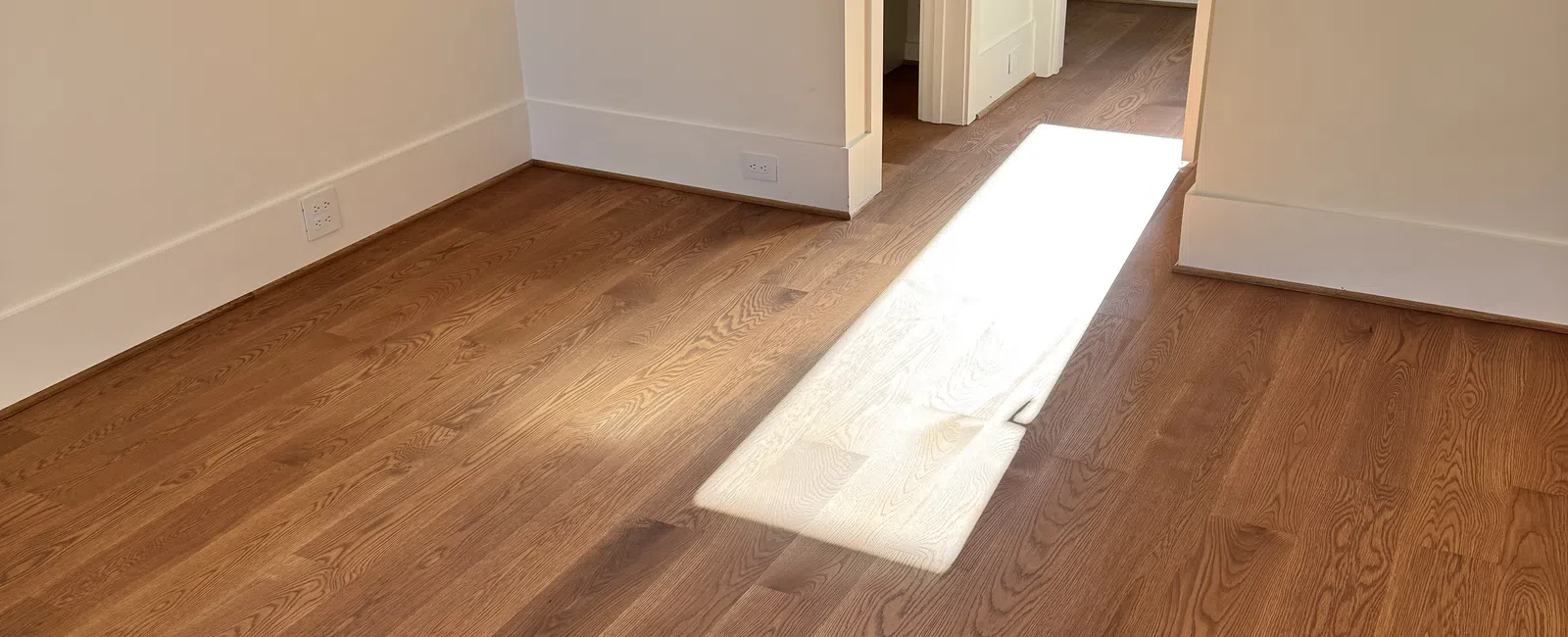
Look down the length of the floor early or late in the day, with light coming in low from a window. Raking light shows what overhead light hides.
You are looking for traffic lanes that read differently from the surrounding floor. A visible path from the door through the kitchen means the finish in that path is thinner. Scratches, swirl marks, and haze all show up in raking light and disappear at noon.
Test 3: The Furniture Comparison
Move a rug or a piece of furniture that has been in place for years. The floor underneath is close to the original color and sheen.
Some difference is normal and is mostly UV exposure rather than wear. A dramatic difference, particularly in sheen rather than color, means the exposed floor has lost finish.
Test 4: The Fingernail Test on a Scratch
Find a scratch and run a fingernail across it.
- Your nail glides over it. The scratch is in the finish only. A recoat will remove it.
- Your nail catches. The scratch has reached the wood. Only sanding removes it.
A floor with a handful of catching scratches is not automatically a refinish. A floor where most scratches catch is.
Test 5: Look for Greying and Staining
Grey or black patches mean liquid has reached the wood and stayed there, which means the finish in that area failed some time ago. Common spots are in front of sinks, around dishwashers, at exterior doors, and wherever a pet spends time.
Greying is a refinish question rather than a recoat question, because a recoat seals the discoloration in rather than removing it. Dark pet staining may not sand out completely, so it is worth documenting and mentioning before a refinish quote is written.
Test 6: Whether Cleaning Still Helps
Deep clean a section properly and look at it the next day. If it comes back to life, the problem was dirt or residue. If it stays dull, the finish is degraded and no cleaning will bring it back.
This one catches a lot of unnecessary refinishing. A cloudy floor is often residue from an oil soap or shine product rather than a worn finish, and that is a stripping job rather than a sanding one.
Recoat Versus Refinish
| What you found | Recoat | Full refinish |
|---|---|---|
| Water beads, floor looks tired | Yes | No |
| Water sits flat, dull traffic lanes | Yes | No |
| Water soaks in | No | Yes |
| Scratches that do not catch a fingernail | Yes | No |
| Scratches that do catch, widespread | No | Yes |
| Grey or black staining | No | Yes |
| Cupping or board damage | No | Yes, after the moisture source is fixed |
| You want a different color | No | Yes |
| Residue haze from old products | Only after stripping | Sometimes simpler |
The difference matters. A recoat abrades the existing finish and adds a fresh coat without touching the wood. It is faster, cheaper, and it does not consume any of the limited number of sandings a floor has in it. A floor recoated on schedule may never need a full sand.
Reasons a Floor Cannot Be Recoated
Worth knowing, because these are the situations where a recoat is quoted and then fails.
- Oil soap or shine product residue. New finish will not bond to it. It has to be chemically stripped first, and sometimes stripping is not fully successful.
- Wax on the floor. Same problem, worse.
- Finish worn completely through in places. A recoat over bare wood patches leaves visible differences.
- Prefinished flooring with a factory aluminum oxide finish. Very difficult to get a new coat to bond, and the reason many prefinished floors are replaced rather than refreshed.
The first two are the argument for never using acidic cleaners, oil soaps, or wax on a finished floor in the first place.
How Many Times a Floor Can Be Refinished
Solid hardwood, typically four to six times over its life, depending on thickness above the tongue. Engineered depends entirely on wear layer: none under 2mm, usually one at 3mm, two or three at 4 to 6mm.
This is the real argument for recoating on schedule rather than waiting. Every full sand spends one of a finite number.
How Often Hardwood Floors Actually Need Refinishing
A full refinish is typically needed every 20 to 30 years with good maintenance, and much sooner in heavy traffic or where the floor has been cleaned with damaging products over that time. A recoat every seven to ten years extends that interval considerably, because it protects the finish without spending any of the wood's limited sanding depth. Floors that get recoated on schedule are the ones that reach the high end of that 20-to-30-year range, and the ones that skip recoating are usually the ones asking this question early.
How Long a Refinish Actually Takes
A main floor typically takes three to five days of active work, sanding through finishing, plus cure time afterward before furniture and rugs can go back. Water-based finishes cure noticeably faster than oil-based ones, which affects how soon the room is usable again. The space is largely off-limits for the full stretch, not just during sanding, so the real planning question is what to do with the room and its contents for the better part of a week rather than just how long the sanding itself takes.
Getting a Definitive Answer on Your Floor
The water drop test gets you most of the way, and a look in person settles it. TriArt Hardwoods recoats and refinishes hardwood across Atlanta, Johns Creek, and Sandy Springs. Our hardwood floor refinishing page has more on what that involves, or our contact page can get a look scheduled.