

Hardwood flooring is a timeless upgrade for homes in Johns Creek, offering durability, style, and increased property value. Whether you’re considering solid or engineered hardwood, choosing the right type for Georgia’s humid climate is essential. Engineered hardwood is especially suitable due to its moisture resistance and stability.
Here’s what you need to know:
- Cost: Installation averages $6–$14+ per square foot, including materials and labor. Solid hardwood often costs more to install than engineered options.
- Types: Solid hardwood lasts longer (80–100+ years) and can be refinished multiple times, while engineered hardwood is better for humid conditions and concrete subfloors.
- Wood Species: Oak, hickory, and maple are popular choices for their durability and aesthetic appeal.
- Installation Methods: Nail-down, glue-down, and floating methods are common, with glue-down being ideal for concrete subfloors.
- Maintenance: Daily cleaning, humidity control (35–55%), and refinishing every 5–7 years keep floors looking their best.
Proper preparation, professional installation, and regular care ensure your hardwood floors remain a lasting investment.
Engineered Hardwood Floor Install // TOP Pro Tips
sbb-itb-9f8f869
Selecting Hardwood Flooring for Your Johns Creek Home
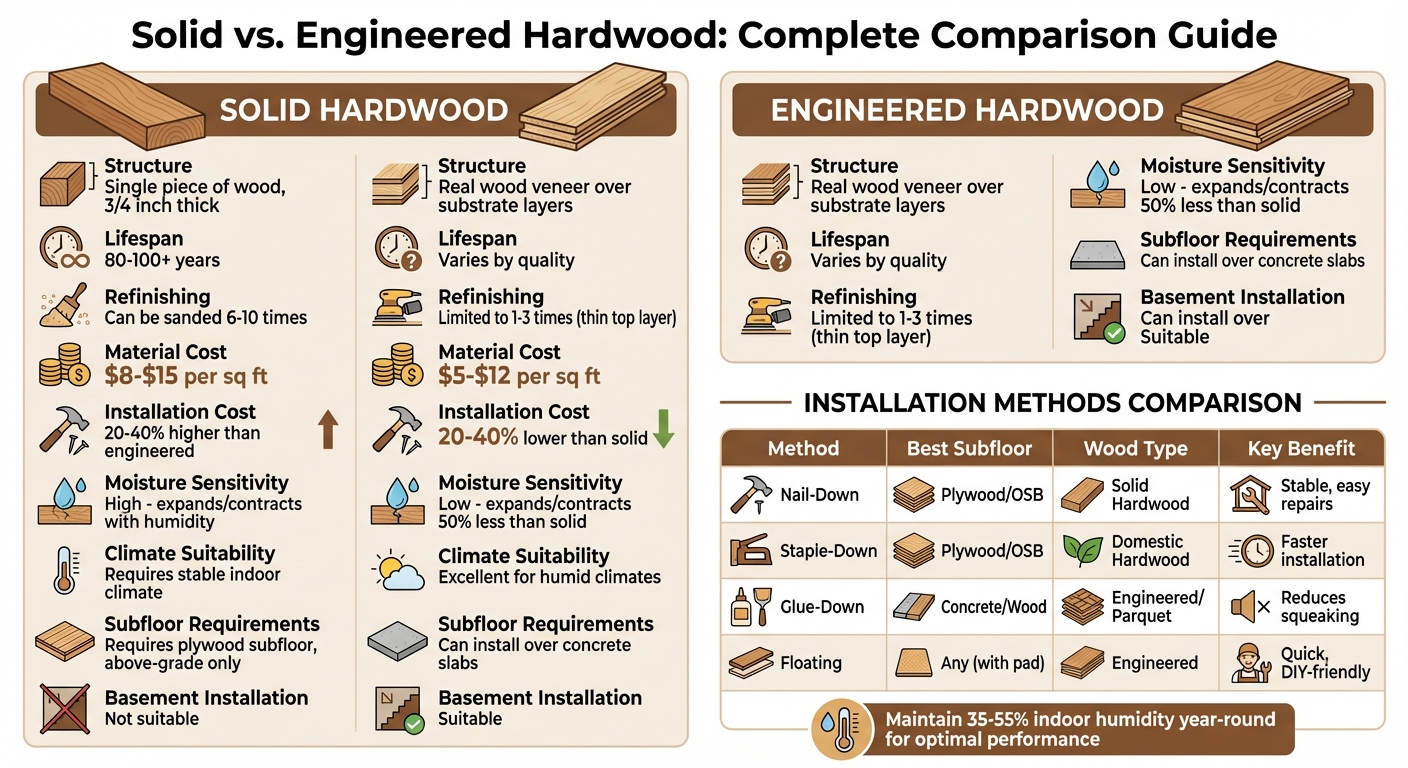
Solid vs Engineered Hardwood Flooring Comparison Guide
Solid vs. Engineered Hardwood: What You Need to Know
When choosing between solid and engineered hardwood for your Johns Creek home, it’s important to consider how each type reacts to the area’s humid subtropical climate. Solid hardwood is a single, thick piece of wood – usually 3/4 inch – that can be sanded and refinished 6 to 10 times over its impressive lifespan of 80 to 100+ years. However, it’s highly sensitive to moisture, so maintaining a stable indoor climate is crucial to prevent warping.
On the other hand, engineered hardwood features a real wood veneer layered over substrates, making it much more stable in fluctuating humidity – expanding and contracting about 50% less than solid wood. As 50Floor explains:
Atlanta’s climate, a dance of humidity and fluctuating temperatures, presents challenges when picking the best types of hardwood floor for your home.
Cost is another factor to weigh. Solid hardwood typically costs $8 to $15 per square foot, while engineered options range from $5 to $12 per square foot. Installation costs for solid wood are 20% to 40% higher than for engineered hardwood. Additionally, engineered hardwood can be installed over concrete slabs, which are common in Georgia homes, while solid wood requires a plywood subfloor and isn’t suitable for basements.
When it comes to refinishing, solid hardwood has the edge. It can be sanded and refinished multiple times, while engineered hardwood is limited to 1 to 3 refinishing cycles due to its thinner top layer. As Premium Prestige Flooring notes:
Solid hardwood wins in the refinishing department – it can be sanded and refinished multiple times, sometimes lasting a century or more with proper care.
To protect your investment, maintain an indoor humidity range of 35% to 55% year-round. A hygrometer can help monitor levels, while dehumidifiers and humidifiers can adjust the climate as needed.
Beyond structural considerations, the choice of species and finishes plays a major role in both the appearance and durability of your floors.
Common Wood Species and Finishes
For homeowners in Johns Creek, oak remains the go-to choice. White oak, with its clean, linear grain, works beautifully in modern and transitional homes, while red oak’s classic cathedral grain complements traditional styles. Both types effectively hide scratches thanks to their active grain patterns.
Hickory stands out for its durability, making it a favorite for families with pets or children. Its bold, contrasting grain masks dents and wear, making it ideal for rustic or farmhouse aesthetics. Maple, with its smooth and uniform appearance, suits minimalist or contemporary designs, though it’s more prone to showing dents than oak or hickory. For a touch of luxury, walnut offers a rich, elegant look that pairs well with mid-century modern or high-end interiors.
When it comes to finishes, matte and satin sheens are popular in the Atlanta area because they conceal everyday wear better than high-gloss options. Natural finishes that highlight the wood’s organic texture are also trending. Wide planks – 5 inches or more – are another favorite, as they create a spacious feel and showcase the wood’s natural grain.
Balancing Appearance and Durability
Once you’ve chosen a wood species and finish, the next step is balancing aesthetics with functionality for high-traffic areas. Spaces like kitchens and hallways demand hardwoods with a Janka hardness rating above 1,240. Hickory and Hard Maple (Sugar Maple) are top performers for resisting dents and scratches, while White Oak, with a rating of 1,320, offers a solid middle ground between toughness and refined style.
Textured finishes – such as wire-brushed, hand-scraped, or distressed – are not just stylish but also practical. They effectively hide scuffs and minor scratches, making them perfect for busy households. As Atlanta Floor One explains:
Choosing between popular wood species for flooring is really choosing the kind of ‘patina’ you’re willing to see. Oak and hickory forgive busy homes, maple stays crisp but shows wear sooner.
Prefinished hardwood, which comes with factory-applied polyurethane or aluminum oxide coatings, offers better scratch resistance than site-finished options. Many prefinished products include a 25-year finish warranty and a lifetime structural warranty. For rooms prone to moisture, like basements, engineered hardwood in durable species provides both stability and longevity.
Before installation, allow your hardwood to acclimate to your home’s environment for several days to prevent gaps or buckling later on. Moisture testing for both the subfloor and hardwood is also essential, especially when installing over concrete. With these steps, you’ll be ready to move on to proper installation and care, ensuring your floors remain beautiful for years to come.
Preparing for Hardwood Floor Installation
Subfloor Inspection and Moisture Testing
Before installing hardwood flooring, it’s crucial to give your subfloor a detailed inspection. Look for any signs of damage, such as squeaks, creaks, splinters, or cracks, as these issues can worsen once the flooring is installed.
Check for pests like ants or termites, which can hide in crevices and cause long-term damage. The subfloor should also be thoroughly cleaned to remove dirt, wax, oil, or any cleaning residues that might interfere with the installation process.
If you’re installing solid hardwood, you’ll need an approved wooden subfloor, and the installation must take place above grade. For homes with concrete slabs – common in places like Georgia – engineered hardwood is usually the better choice. Addressing squeaks and uneven areas beforehand ensures a stable and quiet foundation.
Once you’ve confirmed the subfloor is in good condition, you can move on to acclimating your hardwood under the right environmental conditions.
Material Acclimation and Site Preparation
Hardwood flooring reacts to moisture, absorbing or releasing it to reach a natural balance. In a humid subtropical climate, like that of Johns Creek, skipping the acclimation process can cause problems such as cupping, crowning, warping, or buckling shortly after installation.
Allow the hardwood to acclimate for 2–7 days, though some wood species may need up to two weeks. During this time, remove the planks from their packaging and cross-stack them with spacers to promote air circulation. Store the wood in the room where it will be installed, not in garages or basements, and run your HVAC system for at least five days to stabilize the temperature and humidity.
The ideal environment for acclimation is between 60°F and 80°F, with humidity levels ranging from 30% to 50%. Use tools like a hygrometer to monitor the room’s humidity and a moisture meter to check both the hardwood and the subfloor before installation begins. Avoid placing planks directly on concrete or the subfloor during acclimation, as this can lead to unwanted moisture transfer.
While the wood acclimates, prepare the space by moving furniture out of the room and covering any non-removable fixtures to protect them. Ensure the area is well-ventilated to handle the dust that comes with installation. To secure your installation date, a 50% deposit is typically required when the proposal is accepted.
Hardwood Floor Installation Methods
Once your subfloor is ready and materials have acclimated, the next step is choosing the right installation method. This decision depends on your subfloor type, the hardwood you’ve selected, and the specific conditions in your home. Each method has its strengths and applications, so understanding them is key to achieving a long-lasting floor.
Nail-Down and Staple-Down Methods
Both the nail-down and staple-down methods work best with solid wooden subfloors, such as plywood or OSB, and are commonly used for above-grade installations.
Nail-down installation is a classic technique for solid hardwood floors. Installers drive nails at a 45-degree angle into the tongue of each board, keeping the fasteners hidden once the floor is complete. This approach offers excellent stability and makes replacing individual boards easier if needed.
Staple-down installation is similar, but staples replace nails. While faster and often simpler to execute, this method isn’t recommended for dense hardwoods like Brazilian cherry or teak, as the force of the staples can cause splitting.
"Solid hardwood floors… should only be installed above grade over approved wooden sub-floors and must be nailed or stapled down." – GA Flooring, Inc.
To reduce squeaking and improve insulation, a poly-foam underlayment is often used beneath nailed-down floors. For added durability, especially with wider planks, professionals may install the flooring in the opposite direction of the existing subfloor boards.
Glue-Down and Floating Installation Methods
Glue-down installation involves adhering planks directly to the subfloor with strong adhesives, such as moisture-curing urethane. This method is ideal for concrete subfloors, which are common in Georgia homes, as nails cannot be used on concrete. However, the subfloor must be perfectly level, and a damp-proof membrane is essential to prevent moisture damage.
Glue-down floors feel solid underfoot and are less prone to squeaking compared to nailed floors. This method also supports intricate patterns like herringbone or parquet. For solid hardwood planks wider than 5 inches, a combination of nails and glue is often used to ensure stability.
Floating installation is the simplest method, where planks snap together or are glued to each other instead of being attached to the subfloor. The floor "floats" over a pad or underlayment that provides a moisture barrier and reduces noise. This method works well for engineered hardwood and can be installed over surfaces like vinyl, ceramic, or laminate.
"Floating is an ideal installation method if you need to install new flooring over hard-to-remove surfaces like vinyl, ceramic, or laminates." – First Atlanta Flooring
Floating floors are quicker to install and suitable for DIY projects, though they may have more vertical movement compared to glued or nailed floors. This method isn’t recommended for solid hardwood, as it requires the stability provided by direct fastening. Professional installers can typically cover 300 to 500 square feet per day, depending on the plank width and method used.
| Installation Method | Best Subfloor Type | Recommended Wood Type | Key Benefit |
|---|---|---|---|
| Nail-Down | Plywood / OSB | Solid Hardwood | Stable, traditional, easy repairs |
| Staple-Down | Plywood / OSB | Domestic Hardwood | Faster than nailing |
| Glue-Down | Concrete / Wood | Engineered / Parquet | Reduces squeaking, good for patterns |
| Floating | Any (with pad) | Engineered | Quick installation, DIY-friendly |
No matter the method, professional installers always leave an expansion gap around the room’s perimeter and near immovable objects. This allows the floor to adjust naturally to seasonal humidity changes in Johns Creek.
Cost Considerations for Hardwood Flooring Projects
Understanding Installation Costs
When planning a hardwood flooring project, having a clear grasp of the costs involved is crucial. In Johns Creek, the total cost typically falls between $6 and $14+ per square foot, which includes both materials and labor. Several factors influence where your project will land within this range.
Material costs are a big variable. Domestic wood species usually range from $3 to $8 per square foot, while exotic options can drive costs higher. Engineered hardwood tends to cost $3 to $7 per square foot for materials, while solid hardwood comes in at $3 to $8 per square foot.
Labor makes up a significant portion of the expense – 40–60% of the total project cost. In the Johns Creek area, professional installation typically costs $3 to $7 per square foot. This price reflects the expertise needed for tasks like acclimating the wood, preparing the subfloor, and ensuring precise installation.
Other costs can add up quickly. For example:
- Removing old carpet costs about $1 per square foot.
- Removing glued-down flooring is more labor-intensive and runs $2 to $4 per square foot.
- Subfloor leveling with self-leveling concrete can cost between $1,000 and $1,500 for materials and labor.
- Subfloor preparation and moisture barriers add another $1 to $3 per square foot.
Additionally, it’s wise to order 5% to 10% more material than your measured square footage to account for trimming and layout adjustments.
Here’s an example: In January 2026, the Harrison family in Ohio installed 900 square feet of white oak flooring. They sourced materials at $6.50 per square foot and labor at $4.50 per square foot, bringing their total to around $9,900. By using digital planning tools, they avoided the typical 10% material overage, saving about $600.
With these costs in mind, it’s time to consider how quality impacts long-term value.
Assessing Value and Quality
Understanding costs is just one piece of the puzzle – it’s equally important to evaluate the value and quality behind each estimate. The lowest quote doesn’t always mean the best deal, especially in a humid area like Johns Creek, where proper installation prevents moisture-related issues down the road.
When comparing quotes, check what’s included in the labor costs. Do they cover moving furniture, removing old flooring, or installing custom trim? Stair installation is often billed separately and can add significantly to your budget. Also, ensure contractors allow for proper wood acclimation, which is critical for avoiding future problems.
There are ways to manage costs without compromising on quality. For example:
- Removing old carpet yourself can save about $1 per square foot.
- If a specific wood species is beyond your budget, you could stain a less expensive domestic wood to achieve a similar look.
- Refinishing an existing floor, if structurally sound, is a more affordable option than a full replacement and can still deliver excellent results.
"Labor often accounts for about 40–60% of the total price, depending on local rates and job complexity." – Gabrielle Moss, Author
To avoid surprises, request detailed, written proposals from contractors. These should clearly break down material costs, labor rates, and any additional fees. This level of transparency makes it easier to compare quotes and ensures there are no unexpected charges as the project progresses.
Maintaining Your Hardwood Floors in Johns Creek
Daily Cleaning and Prevention
Taking care of your hardwood floors starts with small, consistent habits. Dust and grit can wear down the finish and cause scratches over time. To prevent this, sweep or vacuum daily using a soft-bristle attachment or a hardwood-friendly vacuum setting to avoid damaging the surface [36,37]. A microfiber mop is another great option – it traps dirt instead of just pushing it around [36,37].
For deeper cleaning, use a damp mop – never a wet one. Too much water can seep into the wood, leading to warping, swelling, or even mold [36,37]. Stick to pH-neutral cleaners made for hardwood, and avoid harsh chemicals like ammonia, wax, or oil-based soaps [35,36,37]. Spills should be blotted immediately with a dry cloth; scrubbing can harm the finish [35,37].
"Because hardwood floors are not waterproof, you should always tend to liquid spills immediately." – Georgia Flooring
Prevention is just as important. Place mats at entryways to catch dirt and moisture, and encourage removing outdoor shoes to keep floors cleaner [35,37]. Attach felt pads to furniture legs to avoid scuffs when moving items, and trim pet nails to reduce the risk of scratches [35,36].
Humidity and Seasonal Maintenance
Johns Creek’s climate brings unique challenges for hardwood floors. Georgia’s high humidity, frequent rain, and fluctuating temperatures can make wood expand and contract more than in drier areas. Because of this, refinishing is often needed every 5 to 7 years in the region.
To protect your floors, maintain indoor humidity levels between 35% and 55% throughout the year. Use a dehumidifier during humid summers and a humidifier in the drier winter months. This helps prevent issues like cupping, where the edges of planks rise, or gapping, which occurs when planks shrink and create spaces between them.
"The combination of high humidity, frequent rain, and temperature fluctuations can cause wood floors to expand, contract, and wear down faster than in drier climates." – Ideal Floors and Interiors
By managing humidity levels and taking seasonal precautions, you can help preserve your floors and reduce the need for frequent refinishing.
When to Refinish or Repair Your Floors
Daily care and controlled humidity can extend the life of your hardwood floors, but knowing when to seek professional help is equally important. Look out for signs like dullness that persists after cleaning, scratches, dents, stains, or peeling finish [22,40]. Physical issues such as splinters, cracks, or squeaky boards may indicate the need for attention before the damage worsens [22,23].
For minor scuffs or dullness, a "Buff n Coat" or screening process can restore the finish without the need for full sanding [23,40]. However, deep scratches, stubborn stains, or a desire to change the floor’s color often require sanding down to the raw wood before applying a new stain and finish.
In October 2025, Hugo and the team at TriArt Hardwood Floors completed a refinishing project for Brenda Karnes in Johns Creek. They restored her damaged floors with precision and met her expectations for the finish.
Addressing damage early not only prevents safety risks, like splinters, but also deters pests such as ants and termites from taking advantage of cracks. When you’re unsure, a professional assessment can help determine whether a repair or a full refinish is the better solution.
Conclusion
Installing hardwood floors in your Johns Creek home is a major decision that demands thoughtful planning and skilled execution. Picking the right material is key – engineered hardwood stands out for its ability to handle Johns Creek’s humid conditions, offering better stability and moisture resistance than solid hardwood.
"Engineered hardwood is an excellent choice for Johns Creek’s humid climate, as it offers greater stability and moisture resistance compared to solid hardwood." – TriArt Hardwoods
Beyond installation, ongoing care is essential to maintain your floors’ beauty and durability. This includes regular cleaning, managing indoor humidity levels, and scheduling refinishing when necessary. If your floors begin to lose their shine, show deep scratches, or look worn, professional refinishing can bring them back to life – without the expense of a full replacement. By combining smart choices upfront with consistent maintenance, your hardwood floors can remain a stunning feature of your home for years to come.
FAQs
How do I choose solid vs. engineered for my home?
Choosing between solid hardwood and engineered hardwood comes down to what works best for your situation. Solid hardwood is crafted from a single piece of wood, making it extremely durable and allowing for multiple refinishes over time. On the other hand, engineered hardwood features a layered construction, which makes it more resistant to humidity and temperature fluctuations – perfect for areas like Johns Creek where the climate can vary.
When deciding, think about factors like your budget, the type of foundation in your home, and how often you might want to refinish your floors. Each option has its strengths, so it’s all about what fits your needs.
How long does hardwood installation usually take?
Hardwood flooring installation generally takes 1 to 3 days, though this can vary based on the project’s size and complexity. If the space is larger or the design involves detailed patterns, it might take a bit longer to ensure everything is done properly.
What should I do to prevent humidity damage?
To keep hardwood floors safe from humidity damage, aim to maintain indoor humidity levels between 35% and 55%. Depending on the season or your local climate – like in Johns Creek – you might need a humidifier or dehumidifier to achieve this balance. Additionally, proper installation methods that factor in seasonal shifts are key to avoiding issues like wood expansion or contraction, helping your floors last longer.


